



It feels like a trick.
You reach for the gear lever, you press the clutch, and for a second—just a heartbeat—it’s 1987 all over again. Then you realize it isn’t.
Ferrari didn’t bring back the stick shift. They simulated one.
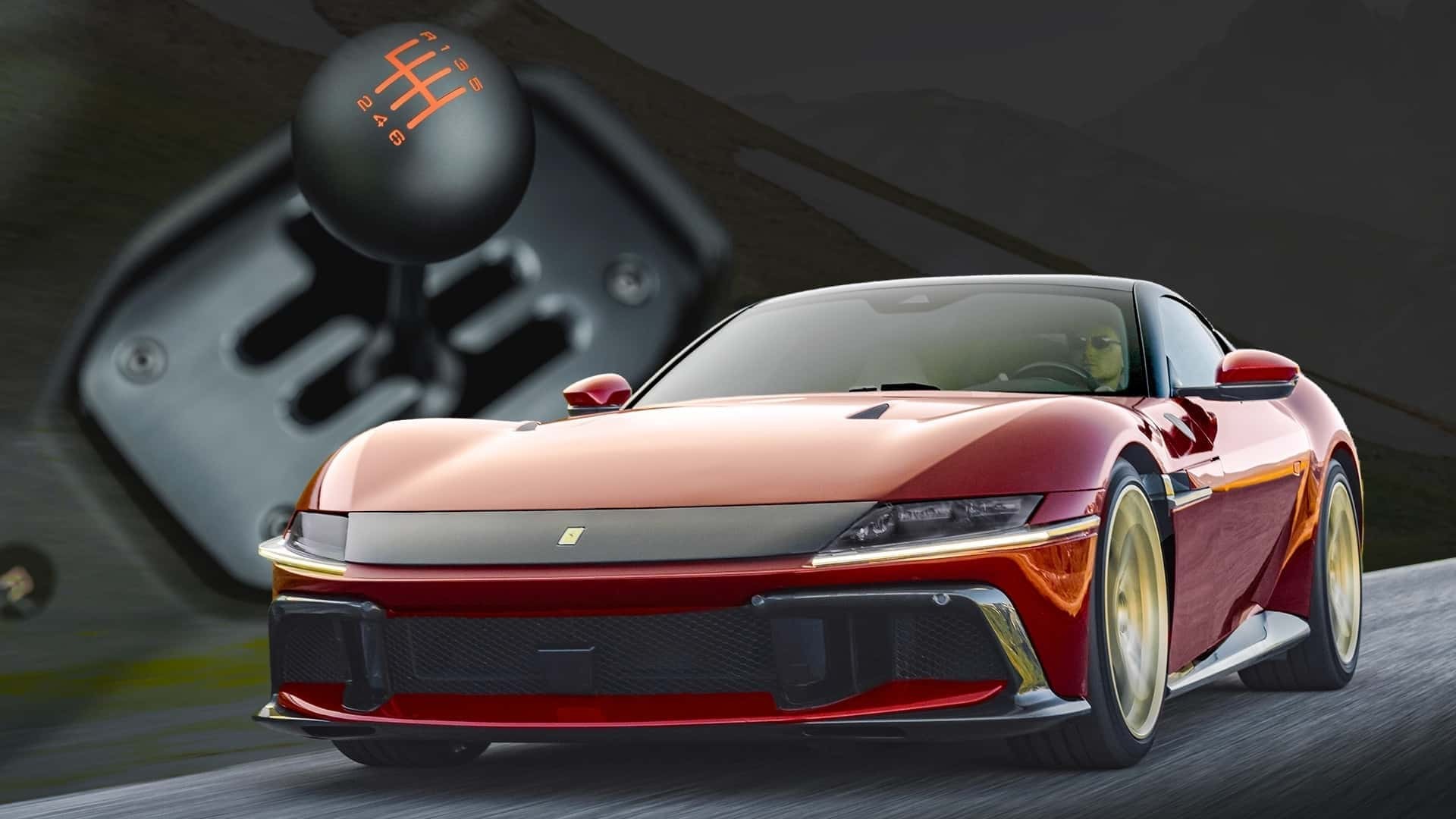
With the 12Cilindri Manuale, Maranello is offering a “Manuale By-Wire” system. It sits inside an 819-horsepower V12 GT, but underneath, the bones are the same as the automatic. It’s a dual-clutch. Always was. But they’ve wrapped that DCT in a digital layer that lets you dance. Or at least, pretend to.
The Illusion Is Real
Listen. There is a clutch pedal. It’s not mechanical. It doesn’t touch the flywheel. An electronic sensor reads your footwork and translates it into hydraulic commands for the twin clutches hidden deep in the gearbox.
You move the shifter through that beautiful, exposed metal gate, and Hall-effect sensors watch your every move.
Does it engage instantly? Yes. Is there a bit of lag? Maybe a fraction of a second as the computer figures out what you’re trying to do. Can you stall it?
Absolutely. And when you do, that natural-aspiration V12 coughs to silence. It feels real because you caused the silence. That is the point.
The standard car has buttons. This has a knob. A polished one, nestled in a gate that reminds you of older, slower times. Ferrari calls it an effort to preserve the “analogue feel.” It’s marketing, sure. But it also works. You aren’t just tapping a paddle. You’re moving your whole hand. You’re thinking about the pattern. One-to-two is straight. One-to-four is the diagonal jump. You learn it again.
Same Engine. New Soul
Under the hood, nothing has changed. Why change a good thing?
The 6.5-liter naturally aspirated V12 is untouched. It breathes on its own, no turbines forced its will, just displacement and intent.
819 horsepower.
500 lb-ft of torque.
0 to 62 mph in 3.0 seconds.
Top speed hits 211 mph.
You won’t be losing performance for the privilege of pretending you’re driving a race car from the 70s. The seventh and eighth gears are there, locked away unless you flip the system back to “Auto” or creep at traffic, which, let’s be honest, is rare.
But here is the kicker.
Rare Air
Ferrari isn’t building thousands of these.
Production is capped. 1,499 units. Just like that. They wanted to tie it to the founding year, 1947 plus 552 equals 1499. Or something equally numerical. It doesn’t matter. The number is low enough to make the bank vault look like an ATM.
Every car comes through the Tailor Made program. You want a specific shade of green for the Alcantara? A logo embossed on the seatback? Pay the money. The base 12Cilindri starts at $423,000. Add the “Manuale” option and the personalization, and the price creeps higher. How much higher? We don’t know. We don’t need to. It’s Ferrari. You pay what it hurts.
Technology is fascinating, even when it’s a lie.
This mirrors what Koenigsegg did with the CC850. Speed of a DCT, soul of a manual. Some hate it. They call it sterile. A video game controller attached to a car. Others love it. They say the connection matters more than the physics.
So which side are you on?
Does it matter if the gears aren’t metal meshing with metal, as long as your fingers feel the rhythm? Or is it just an expensive toy for people who missed the way cars used to fight back?
The engine starts. You press the fake clutch. You push the gear forward. The V12 roars.
For now, that has to be enough.