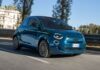




You want the greenest car on the road that doesn’t involve pedaling up a hill. Natural gas fits that bill. The Green Car Journal even handed the “Green Car of the Year” title to a natural gas vehicle this year. On paper, these cars are cleaner and cheaper to run than their gasoline or diesel cousins.
So why isn’t everyone driving one?
The CNG Station Gap Is Real
Infrastructure is the killer. You can’t just pull into any corner gas station. There are fewer than 1,000 compressed natural gas (CNG) stations in the entire United States. Some states have zero.
Try planning a cross-country road trip with that map. You can’t.
The lack of infrastructure is one of the biggest reasons that natural gas powered vehicles haven’t taken off.
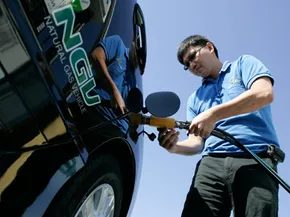
There is a workaround. Home refueling. But that’s not free. You pay for the compressor system and the installation costs. It’s an upfront hit that most consumers aren’t willing to take.
The Cost Comparison
Theoretically, fuel costs are lower. Natural gas is often cheaper per energy unit than gasoline or diesel. But the math gets messy when you factor in the vehicle price and the home setup.
It’s not just about the pump price. It’s about where you can pump.

The CNG Price Gap and Range Anxiety
CNG costs roughly half what gasoline does. In San Diego last July, the spread was stark. CNG sat at $2.89 a gallon. Gasoline hit $3.80. Home refueling drives that number even lower. But does saving a few bucks justify swapping your daily driver for a compressed natural gas vehicle?
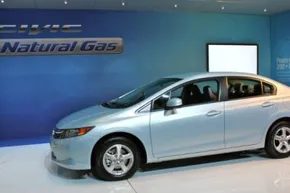
The upfront hit stings. Honda stands alone in the US market offering a factory CNG option. The 2012 Honda Civic Natural Gas tags in at $26,155. A comparable gas-powered Civic EX runs about $20k. Even the Hybrid starts lower at $24k. That $6k premium over the EX isn’t just a tax on green virtue. It buys you compromises.
The car looks identical. Under the hood sits the same 1.8L four-cylinder. But natural gas packs less energy than gasoline. The engine drops from 140 horsepower to 110. Power isn’t the only casualty. EPA ratings claim 27 mpg city and 38 highway. Those are gasoline-gallon equivalents, mind you. The real killer is range. You get 240 miles max. A gas Civic stretches to 500. The Chevy Volt manages 350. Then there’s the cargo hold. The massive CNG tank eats up half the trunk space.
Who Actually Buys a CNG Car?
If the math doesn’t work for a commuter, who is it for? Fleets. Mostly government or municipal fleets that refuel at home or central depots. They don’t care about trunk space for vacation luggage. They care about per-mile operating costs.
Individual buyers face a harder sell. You need a garage for a home dispenser. You need to drive high annual miles to break even on the sticker price. And you need to ignore the fact that CNG stations are sparse outside major urban centers like San Diego.
It’s a niche product. Built for specific use cases. Not for the weekend road tripper.
Who actually buys the Honda Civic Natural Gas
Honda has a very clear picture of who drives the NGV model. It is not your average Civic buyer. The data shows a stark divide.
The typical Natural Gas Civic driver is 52 years old. Their median household income sits at $225,000. Compare that to the gasoline Civic buyer, who is 43 with a median income of $65,000.
The gap is massive.
Why does this matter? Because the economics don’t work for the mass market. Most cost-conscious shoppers look at the sticker price and the limited range of the natural gas tank and walk away. The higher upfront cost combined with range anxiety kills the deal for anyone without a six-figure income.
Is natural gas a viable alternative to hybrids and EVs?
Right now, natural-gas vehicles live in the fleet sector. They are the cars you see for municipal services or rental companies, not parked in suburban driveways.
Will they ever catch the hybrid or electric wave? Probably not.
Natural gas cars occupy a weird middle ground. They offer an alternative to pricier electric vehicles, especially since both suffer from range limitations that make long road trips stressful without planning. But hybrids remain the smarter play. Until a dense network of refueling stations appears, hybrids bridge the gap between efficiency and convenience without forcing you to hunt for a niche fuel source.
The natural gas Civic is a niche product for a specific demographic. It is not a mass-market solution.
For now, the buyers are people who prioritize greener driving enough to tolerate the drawbacks. They have the money to absorb the higher costs and the patience to deal with the infrastructure gaps. Everyone else? They are waiting for better batteries or just sticking with gas.