

Joe Frazer wasn’t just a car salesman. He was a Virginia aristocrat with a knack for moving metal. He’d pedaled Packards, Pierce-Arows, and GM products before helping Walter P. Chrysler in the 1920s. He even dragged Willys-Overland out of the grave in the late 1930s. But his real legacy? A partnership that birthed one of the most confusing, short-lived, yet fascinating entries in Kaiser-Frazer history.
By the early 1940s, Frazer was already plotting a postwar sedan. Henry J. Kaiser, the West Coast tycoon who built Liberty ships at breakneck speed during WWII, had the same idea. They met. They clicked. July 1945 saw the formation of the Kaiser-Frazer Corporation. Frazer took the presidency. Kaiser became chairman. It looked like a match made in heaven. Sales genius met manufacturing muscle.
Design Compromises and The Willow Run Dream
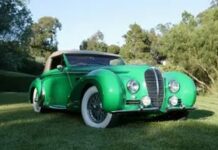
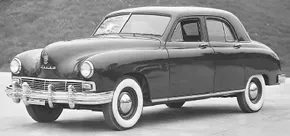
They toyed with ideas. A radical front-wheel-drive layout made the cut before being tossed. What survived was conventional rear-drive. Four doors. Flush fenders. Howard A. “Dutch” Darrin, a famous custom-body designer, lent his hand to the styling. The result? Smooth. Stylish for 1946. Except for that high, blunt hood. Darrin didn’t love it. Neither did many others.
Production plans were split. Kaiser would build the medium-priced Kaiser brand. Frazer would handle the luxury Frazer. Kaiser bought Ford’s massive Willow Run bomber plant in Michigan for the Kaisers. Frazers? They were supposed to roll off the assembly lines of Graham-Paige in Detroit, a company Frazer and his associates had recently acquired.
Then Graham-Paige stumbled. In 1947, Kaiser-Frazer bought them out. Suddenly, all but the earliest Frazers were built alongside Kaisers. The separation vanished.
The Supersonic Six That Wasn’t
Both brands launched in June 1946 for the 1947 model year. Two tiers: basic and upmarket. Frazers came as the “Standard” and the “Manhattan.” One engine only. A 226.2 cubic-inch flathead six. Long stroke. Based on the Continental “Red Seal” design, but improved. Mostly built by Kaiser-Frazer themselves.
Advertisers called it the “Supersonic Six.” The reality? 100 to 110 horsepower pushing over 3,300 pounds. It didn’t feel supersonic. It felt like work.
Inside, however, the Darrin-styled body delivered. Exceptional room. The industry’s widest front seat, measuring a staggering 64 inches. The chassis was rugged too. Box-section construction. Modern front coil springs. Rear leaf springs. Solid engineering.
Price, Tech, and The “Postwar Wonder”
Initially, Kaiser-Frazer built two Kaisers for every one Frazer. Why? Because Frazers cost more. Starting at $2,295. That put them in Cadillac territory. The Manhattan edition added another $400. It came with elegant nylon and Bedford cord cloth upholstery, color-keyed to the exterior. Two-tone paint jobs were standard. Full leather was an option.
So what was missing? An automatic transmission. None. Not even close to the ultrasmooth Hydra-Matic. Buyers got a three-speed manual. Or the same three-speed with optional Borg-Warner overdrive for $80.
No V8 in sight. Stiff prices. Manual gears only.
Yet the public bought them. The press dubbed Kaiser-Frazer the “postwar wonder company.” They were the highest-volume independent in 1947 and 1948. Ninth place in the overall production race.
Critics remained skeptical. Henry Kaiser didn’t know cars from motorboats, they said. Frazer had only sold cars, never built them. But the company survived. How? A crack team of expediters scoured the country for materials. Sheet steel. Copper wire. They found it. They paid for it. That’s why the cars cost so much.
Materials shortages plagued the era. Kaiser-Frazer navigated them. For a brief moment, they weren’t just surviving. They were winning. Then the money ran out. The style aged poorly. The price stayed high. The end came quietly. But for a few years, the big box-section chassis carried more than just passengers. It carried the weight of an impossible dream.
The Frazer’s Rise and Fall: Style Over Substance
There was a reason the Kaiser and Frazer survived when so many startups failed. They were clean sheets. No war-torn legacy, no outdated tooling holding them back. They arrived when the market was thirsty, while legacy makers were still figuring out how to ramp up prewar designs. But looking good was only half the battle.
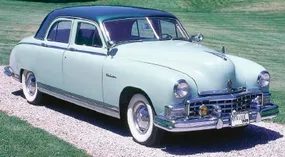
The design was crisp. Darrin’s influence was clear in the modest horizontal grilles and the lack of excessive chrome or sculptured fluting. It was restrained. Elegant, even. Underneath that clean skin sat a 123.5-inch wheelbase. That length meant a smooth ride. The inline-six engine was sluggish, sure, but it sipped fuel. In a different market, that efficiency would have been a selling point.
It wasn’t.
Buyers in the late 40s didn’t want efficiency. They wanted presence. They wanted V8 power and interiors that sparkled. The Frazer offered none of that initially. When Henry Kaiser finally blinked and added optional hood ornaments and glittering interiors, it was too late. The core problem remained: no eight-cylinder option. At the price points they were charging, that missing horsepower was a fatal flaw. Sales couldn’t keep up with the hype.
Tracking Down a Defunct American Classic
If you are hunting for these cars now, knowing their history helps. You aren’t just buying a car; you are buying a piece of post-war industrial ambition.
- AMC : A later survivor of the consolidation, but shares that small-car DNA.
- Duesenberg : The luxury benchmark the Frazer tried to chase from a distance.
- Oldsmobile : The V8 powerhouse that made the Frazer feel inadequate.
- Plymouth : The mass-market competitor that dominated the low-end.
- Studebaker : Another survivor, but with a different trajectory.
- Tucker : The most famous failure, often compared to the Frazer’s high-profile debut.
The Frazer Model Years: 1948, 1949, 1950, and 1951
The production run was short, but the changes were telling.
1948
The debut year. The sedan and coupe were the main offerings. The inline-six was the only engine. Sales were strong at first, buoyed by the novelty of a new American brand with serious backing. The clean lines stood out against the chrome-heavy competitors.
1949
Minor updates. The grille was tweaked slightly. The interior received more cloth and less plain fabric. But the lack of a V8 remained a constant complaint in automotive press reviews. Potential buyers were looking at the Chevy 216 or the Ford V8 and wondering what they were missing for a similar price.
1950
The writing was on the wall. Sales dipped. Kaiser-Frazer tried to respond with more comfort features, but the fundamental formula was broken. The car was too expensive for its performance and too underpowered for its price tag. The “all-new” advantage had worn off. Competitors had caught up, and then surpassed.
1951
The end. Production ceased. The 1951 models
The Descent into Irrelevance
The Frazer never truly evolved. By 1948, the changes were cosmetic, yet the price tag crept up to $2,483–$2,746. In a postwar seller’s market where demand outstrips supply, this stagnation should have been a non-issue. It wasn’t. Sales plummeted from 68,775 units to a dismal 48,071. The formula was stale, and buyers knew it.
Then came the strategic blunder that killed the brand. Joe Frazer, recognizing the gap between his facelifted product and the all-new offerings from the Big Three and Nash, proposed a pause. Cut 1949 production. Use the time to engineer a complete redesign for 1950. Henry Kaiser disagreed. His response was less about business logic and more about ego: “The Kaisers never retrench!”
Kaiser won. Joe Frazer resigned, retreating to the powerless role of board vice-chairman. Henry replaced him with his own son, Edgar. The company geared up for 200,000 units. They sold 58,000. The slide had begun.
The $3,000 Mistake
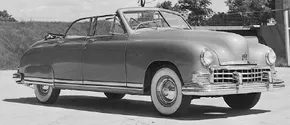
For 1949, the Frazer received an eggcrate grille, rectangular parking lamps, and vertical two-lens taillights. But the headline was the new four-door Manhattan convertible. It was a desperate measure. Engineers John Widman and Ralph Isbrandt were ordered to create a droptop or die. They took a sedan, sheared off the roof, and kept the B-pillars with small inset windows. To support the flimsy structure, they sourced heavy-duty X-member frames at a premium cost.
The result cost over $3,000. In 1949, that was a fortune. It was also a flop.
Sales of any 1949 Frazer were so weak that roughly 5,000 unsold units were re-serialized for a brief 1950 model run. Total production for those two seasons hovered just under 25,000 units. Only 70 of those were the four-door convertibles. Estimates suggest just 15% of the total run was sold as 1950 models. The rest sat in lots, gathering dust.
The Final Redesign
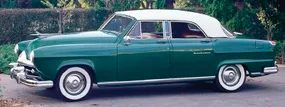
1951 was abbreviated, but the cars looked different. Herb Weissinger of K-F Styling redid the front and rear ends. The goal was simple: use up the remaining 1949-50 body shells.
Leftover Kaiser Vagabond utility sedans—featuring a double hatchback and folding rear seat—became the standard 1951 Frazer Vagabonds. Kaiser Virginian four-door “hardtops” were rebadged as 1951 Frazer Manhattans. Pillared sedans made up the standard line, but they were trimmed to match the 1950 Manhattan level.
There was one glimmer of hope. Hydra-Matic automatic transmission arrived as a $159 option. Dealers, sensing a lifeline, ordered 55,000 units. Kaiser-Frazer delivered only 10,214.
The brand was dead.
The Kaiser Aftermath
The design team at K-F had already churned out a stack of renderings for future Frazers. They were built on the bones of Darrin’s 1951 “Anatomic” Kaiser. Sleek. Low. The kind of styling that screams future.
But the plans died in the crib.
Joe Frazer walked out the door in early 1949. With him went the vision. The rest became history.
Two years later, Kaiser was scrambling. They were busy producing the Henry J. A new small car. A budget-friendly compact to keep the lights on. Meanwhile, leftover ’51 Kaisers were gathering dust in the warehouses. Storage space was money. Money was tight.
Looking back, the missed opportunity is glaring.
They should have listened to Joe.
The “Anatomic” design was ahead of its time. It was aerodynamic. It was modern. Instead of pivoting to a luxury niche, Kaiser doubled down on volume. The Henry J sold well. But it didn’t have the soul of the Darrin concept.
The K-F stylists had the right idea. They just lacked the patience.
For more on defunct American cars, see:
-
AMC
-
Duesenberg
-
Oldsmobile
-
Plymouth
-
Studebaker
-
Tucker