




There is a familiar trope in crime cinema. The getaway crew disconnects the getaway car, leaving the loot rolling away in a controlled chaos. They have the situation handled. It’s a fantasy of precision.
Real life is less cinematic. More dangerous.
When you are hauling a heavy load behind your truck or SUV, the risks shift dramatically. You are not worried about bandits stealing your cargo. You are worried about physics. A detached trailer is a ballistic projectile. It has momentum. It has mass. And if you are miles down the highway, it has no driver.
A breakaway failure is the ultimate towing nightmare. You can fight trailer sway. You can correct for uneven weight distribution. You cannot correct for a trailer that has completely severed its connection to your tow vehicle. Once that hitch fails, the trailer becomes an independent entity. It will not stop on its own. It will coast until it crashes or loses speed.
This is why breakaway kits are not optional extras. They are mandatory safety gear. Most states legally require them. The logic is simple: if the hitch fails, the trailer must apply its own brakes to prevent a catastrophic accident.
But how do these systems actually work? Which type fits your rig? Can you wire one yourself, or does it require a certified mechanic?
Understanding the Mechanics of Safety
A breakaway kit is essentially an emergency brake system for your trailer. It operates independently of your tow vehicle.
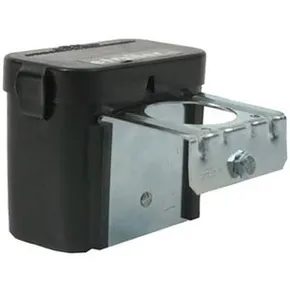
The core component is a battery pack. This is usually a sealed lead-acid or lithium battery housed in a weather-resistant box. Attached to this box is a cable or pin mechanism. This cable connects to the trailer frame or hitch assembly.
Here is the sequence of events when disaster strikes:
- The trailer separates from the tow vehicle.
- The cable is pulled taut.
- A safety pin or tether is released.
- The circuit closes.
- The battery sends power to the trailer’s electric brakes.
- The trailer slows down and stops.
Without this system, a detached trailer is just a rolling hazard. With it, you have a failsafe. The system is designed to activate only when necessary. You do not want your trailer braking hard every time you hit a bump.
Types of Breakaway Kits
Not all kits are created equal. The market offers two primary configurations. Your choice depends on your trailer type and your towing habits.
Electric Breakaway Kits
These are the most common type for boat trailers and enclosed cargo trailers. They use an electric motor to engage the trailer’s existing brake assembly.
- Power Source: A dedicated 12-volt battery.
- Activation: A cable or pin that triggers an electrical switch.
- Best For: Trailers with electric-over-hydraulic brakes or standard electric drum brakes.
- Pros: Relatively easy to install if you have basic wiring skills.
- Cons: Requires regular battery maintenance. Dead battery means no safety net.
Hydraulic Breakaway Kits
These are popular for boat trailers. They use a hydraulic pump to pressurize the brake lines.
- Power Source: A small hydraulic pump powered by a battery.
- Activation: Similar cable/pin mechanism
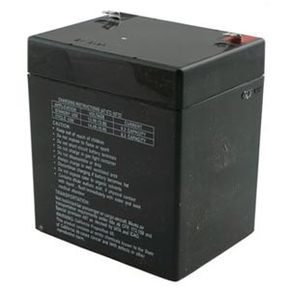

Most breakaway kits look exactly the same. You get a plastic bin, a sealed battery, the switch mechanism, and the wiring harness. They are light. Three to eight pounds is the standard range. Dimensions hover around five or six inches on all sides. Think thick textbook. You can mount them almost anywhere. The frame works. Inside the trailer body works too.
Price variance is the only real differentiator. Ten dollars gets you the basics. Forty dollars buys you better specs. Seventy dollars is the ceiling for most setups. Why the spread?
First, compatibility dictates cost. A kit for a single-axle trailer is cheap. It does one job. A kit for single, tandem, and tri-axle setups costs more. Universality has a premium.
Second, battery type. Non-rechargeable cells are cheaper upfront. Rechargeable packs cost more. They are the smarter buy. You stop replacing expensive dead batteries. You stop buying separate chargers. The math works out faster.
“More universal a kit is, the more expensive it will be.”
Installing Breakaway Kits
Securing the Breakaway Battery and Switch
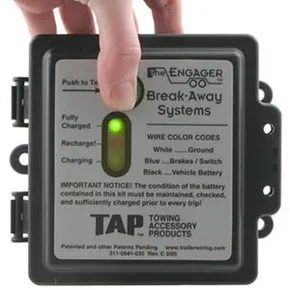
You’ve picked the hardware. Now you have to bolt it down. It’s not rocket science. Most kits arrive with a bracket or pre-drilled holes in the plastic battery case. You just need a wrench and a plan.
Where you mount the battery box? Your call. Inside the tongue is safe from weather. The frame rail is easier to reach. Pick what makes sense for your trailer’s geometry.
The switch is the other half of the equation. Mount it where it won’t get smashed by road debris. Don’t hide it under a fender. Keep it visible.
And check the wire length. Seriously. Measure twice.
Wiring the Breakaway System
This is where things get tricky.
If you’re not comfortable stripping wires and using a crimping tool, hire a pro. Electrical mistakes on a trailer can mean fire. Or worse, brakes that don’t work when you need them.
Here is the flow. Simple, but precise.
- Battery positive goes to the breakaway switch input.
- Battery negative grounds to the trailer chassis.
- The switch output splices into the trailer’s electric brake line.
The switch acts as a circuit breaker. It’s often called a plunger switch. When the hitch ball pulls away from the coupler, the cable yanks the plunger. The circuit closes. Power flows from the battery straight to the brakes.
Emergency stopping power. Instantly.
No delay. No negotiation. Just hydraulic pressure building up in the calipers or drums.
If you mess up the polarity, nothing happens. The trailer keeps rolling. That’s a problem.
So double-check your connections. Heat shrink the splices. Protect them from moisture.
Because when you’re on the highway and that hitch fails, you don’t want to be guessing which wire does what.