


Smart is ditching the digital ad space. Instead of algorithm feeds, the company is painting its future on the walls.
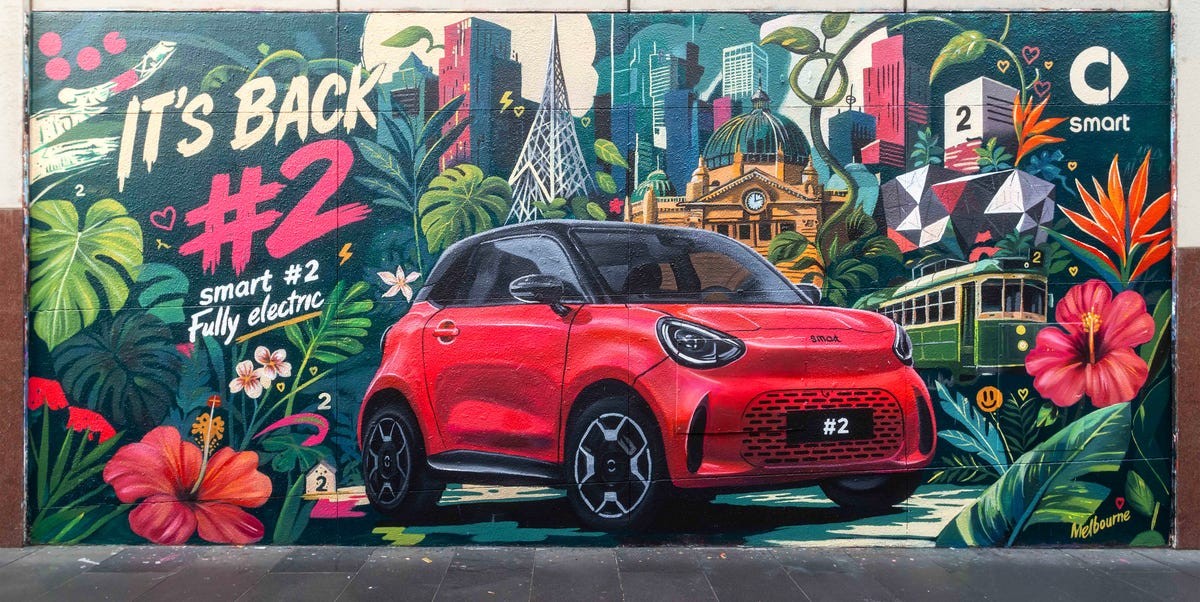
Commissioned artists in Shanghai, Buenos Aires, and Melbourne just dropped murals. They reveal the styling for the #2. This tiny two-seater marks a sharp pivot back to Smart’s origins. It mimics the proportions of the classic Smart ForTwo. That model was killed off in the United States back in 2019.
The full reveal happens in October at the Paris auto show.
Here is the catch. The new model will not be sold in America.
The Art of the Reveal
Forget social media campaigns. This launch strategy feels analog for an EV company. Smart used local artists to paint the car into urban environments. They picked cities that actually make sense for a micro-car.
Berlin, Paris, Hong Kong. These places have narrow streets. They need small cars. The United States is missing from this list entirely. We haven’t had a new Smart car since 2009. The brand pulled the plug here five years ago. The #2 won’t change that policy.
Smart claims the electric hatchback is meant to “spark joy.”
The focus remains on playful, ultra-compact design. But the murals tell a more serious story than the concept car did.
Design Details: Real vs. Concept
Earlier this year, Smart showed the #2 concept at the Beijing auto show. That car was flashy. It had pixellated LED screens on the side panels that scrolled the “#2” logo. It had door handles made of leather.
The murals strip that away.
The production design is more subdued. It is practical.
The front end now features a sleek, swooping nose. There is a body-colored grille. The holes in it are thin and horizontal. The headlights are teardrop-shaped. They give the car a friendly, almost dumb look. You could say it has character. Or you could say it looks like a toaster with wheels.
The concept’s flashy side screens are gone. The production car relies on traditional pull handles instead of the leather grips seen on the show model.
Stubby Silhouette and LED Taillights
The rear view confirms the compact nature of the vehicle.
Bulging circular taillights sit on a simple hatchback. There is a small spoiler on the roof. It is minimal.
The wheels tell another story. The murals show a four-spoke design. The spokes are outlined in silver. This detail emphasizes the car’s stubby, low-profile stance.
It is a design language built for city driving. Not for highway cruising.
Performance Specs: Fast Charge, Short Range
Murals can’t convey speed. But the specs are clear enough.
The #2 is fully electric.
Smart claims it can charge from 10% to 80% in less than 20 minutes. That is fast for a vehicle this small. The range is roughly 186 miles. That number feels adequate for a primary urban commuter. It is not built for road trips. It is built for parking.
The US Market Reality
So, why no US launch?
Smart exited the American market in 2019 when its partnership with Daimler ended. The brand hasn’t looked back. The #2 represents a return to form. It brings back the two-seat layout. It shrinks the footprint.
But the American car market hates small cars. It demands SUVs and trucks. A tiny electric hatchback struggles to gain traction here without aggressive subsidies or a change in consumer taste.
Smart seems to agree. They are targeting Europe, Asia, and Latin America with this release.
The Paris auto show in October will show the real deal. Until then, the murals serve as the only preview.
You won’t see these buzzing through Los Angeles traffic. Or New York gridlock. You might spot them in Paris, though.
That seems fair enough.