



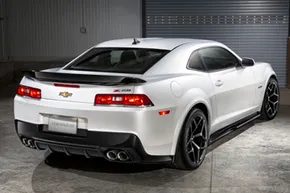
Two shiny chrome tips poking out of the rear bumper. It looks cool. It screams “performance.” But let’s be honest for a second. For years, car culture whispered that dual exhaust was just a cosmetic lie. A gimmick for posers who wanted to look fast without being fast. You see the tips. You assume the power.
It’s almost always wrong.
Dual exhaust isn’t just for show. It changes how your engine breathes. And in the world of internal combustion, breathing is everything.
The Science of Clearing the Cylinder
Every engine cycle ends with one messy step: the exhaust stroke. The pistons have to push out all that hot, spent air and unburnt fuel before they can suck in a fresh charge to ignite. It’s a bottleneck. If the exit is clogged, the intake is choked.
Paul Eklund, driver and team owner for Primitive Racing, puts it simply.
“If you have more air moving and more horsepower, it needs more exhaust.”
Think of it like a hallway. If ten people need to leave a room through a single narrow door, it takes time. If you open two doors, they clear out twice as fast. That’s what a proper dual exhaust system does.
In V-6 and V-8 engines, you typically have two banks of cylinders. A true dual setup gives each bank its own dedicated path to the rear of the car. Less backpressure. Faster scavenging. When the cylinders clear faster, the next intake stroke happens sooner. The engine spins up quicker. You get more power down the drag strip.
(And yes, you should only do this on the strip. Not the city street. Please.)
When Does It Actually Help?
Here is where most people get it wrong. They slap a dual tip kit on a base model Ford Focus and wonder why their 0-60 times didn’t drop.
Adding a dual exhaust to a small engine, like a standard inline-four, won’t do much. The engine doesn’t produce enough exhaust volume to make the extra pipes matter. Unless, of course, you have already built it into a monster.
Eklund notes that if you have a turbocharged inline-four making around 400 horsepower, then yes. You need those extra pipes. You need to get that exhaust gas out of the way immediately to keep the turbos spooling. For a stock daily driver? You’re wasting money.
The “Fake Dual” Trap
This is the most critical part of the equation. You can buy a cheap aftermarket kit that looks like a dual exhaust. It has two tips at the back. But under the hood, it’s just one pipe running from the engine, splitting into two tubes only after it passes the muffler or near the bumper.
That is not a dual exhaust. That is a single exhaust with a decoration.
It accomplishes exactly nothing for performance. The backpressure remains identical. The scavenging effect is zero. Your car looks “totally boss” but performs exactly like the stock version. Don’t fall for it. If the pipes don’t separate at the headers or the Y-pipe near the engine, you aren’t getting dual exhaust performance.
Breaking Down the Components
To understand why this matters, you need to know what you’re looking at. A complete exhaust system isn’t just pipes and a muffler. It has five main parts:
- Exhaust Manifold: Where the cylinders dump their waste.
- Oxygen Sensor: Monitors the mix.
- Exhaust Pipes: The road the gas travels.
- Catalytic Converter: Cleans the emissions (mandatory in most places).
- Muffler: Dampens the noise.
When people talk about upgrading, they usually talk about “cat-back” systems. This refers to everything from the catalytic converter backward. It includes the middle pipes, any resonators, and the mufflers.
Why upgrade cat-back? Because it’s the easiest bolt-on. You’re replacing the restrictive factory pipes and mufflers with larger-diameter, less restrictive parts. It lets the engine breathe easier at high RPMs.
How Much Power Do You Actually Gain?
Let’s look at the numbers. There’s a lot of hype about “free horsepower.”
According to data from ExhaustVideo.com, the most horsepower you’ll realistically gain from an exhaust upgrade is between two to five percent.
Five percent sounds small until you realize that’s the difference between a 10-second quarter-mile and a 9.9-second one. It’s