




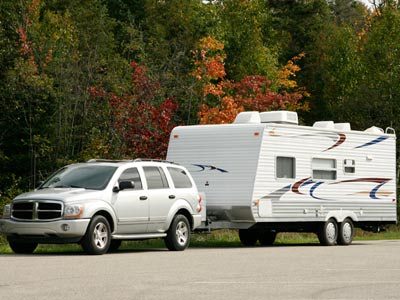
Escape the cubicle. Pack the tent. Get the kids out of the house and into the lake. It is the perfect antidote to a stressful material world. There is nothing quite like campfire food and fresh air.
But there is one memory you definitely do not want to make. It is getting pulled over by state troopers because you ignored the rules of the road. Specifically, trailer towing regulations.
You might think you can just haul the biggest, baddest camper money can buy. You cannot. States restrict length, width, and height. They also care deeply about weight. Why does weight matter? Because braking becomes exponentially more dangerous with extra mass. If your rig is too heavy, you need special brakes. Police might not stop you for bad brakes until you crash, but a post-accident investigation will find them. And that is when you are in hot water.
Planning a trip means more than remembering flashlights and hot dogs. It means obeying trailer towing safety rules. You must know the guidelines for your home state and every state you drive through. If your trailer exceeds legal limits, you may need a special license just to cross a state line.
It feels like a pain. Towing seems like a logistical nightmare. But we are going to simplify it. We will break down the basics all states require and the stricter rules that catch people off guard.
The Cross-State Trap
Road trips cross multiple jurisdictions. You might be a law-abiding tower in Alabama. But cross into Mississippi and you are suddenly breaking laws.
Speed limits drop. The maximum towing speed in Mississippi is 10 mph lower than in Alabama. Width restrictions tighten. The maximum width narrows by six inches (15 centimeters) when you cross certain borders. Weight limits for brake requirements fall by 1,000 pounds.
Then there are the weird ones. Multiple trailers. If you are hauling a camper and a Jet Ski behind it, you are fine in South Carolina. Cross into Georgia and you are breaking the law.
These laws get confusing fast. Let us cut through the noise.
What Every State Requires
No matter where you are in the U.S., your trailer must have these two things. If you do not have them, you are not road-legal.
- Taillights : Operable taillights are non-negotiable for basic road safety.
- License plate light : You must clearly display your license plate with its own dedicated light.
Beyond those bare necessities, common sense dictates you need more. The vast majority of states also require:
- Safety chains : These cross in an X-shape to connect the trailer to the tow vehicle. If the hitch fails, these chains prevent the trailer from separating and becoming a projectile.
- Brake lights : Your trailer is not transparent. People behind you are already struggling to see around your bulk. They need to know you are stopping.
- Clearance lights : Required if your trailer exceeds a certain width.
- Turn signals : If your vehicle’s signals are blocked by the trailer, the trailer needs its own turn signals.
- Reflectors : Invaluable for keeping your large profile visible at night.
The Strict States
Some states demand extra gear. They do not trust you to handle the momentum.
- Breakaway brakes : Like safety chains, these prevent accidents if the hitch fails. These are power brakes that apply automatically to the trailer if it separates from the tow vehicle.
- Flares : You need these to clear off a section of the road after an accident.
- Tie-downs : If you are loading anything that could fall off, you need tie-downs to secure it at multiple angles.
Improper braking is the biggest mistake new towers make. It is also the easiest to mess up. More weight means more momentum. More momentum means a longer stopping distance.
This is why most states require trailer brakes when your rig exceeds a specific weight limit. Sometimes that limit is as low as 1,500 pounds (680 kilograms). It is not just about the weight. Speed matters too. All states stipulate a maximum towing speed. In some places, it is as low as 45 mph (72 kph).
Dimensions That Get You Ticketed
Dimension requirements vary wildly. This is where the casual towers get burned.
A trailer typically must be as narrow as 8 feet or 8 1/2 feet. Exceed that and you are in trouble. The length of the entire rig is often restricted. Sometimes the total length is capped at 53 feet (16 meters). Other times, the trailer itself cannot be longer than 35 feet (10.7 meters). Height is often capped between 12 and 14 feet (3.7 to 4.3 meters).
If you end up in an accident, insurance matters. We will talk about trailer towing insurance next.