

It’s sleeting. It’s raining. It’s doing both at the same time. Someone put dish soap on the road. The tanker truck that just wrecked in front of you was filled with melted butter. All you want to do is get home and out of the snow/rain/dish soap/butter before “Community” comes on.
So you go a bit faster than conditions require. You push it at the yellow light, because it’s safer to keep going around that turn than to suddenly stop, right? Stopping is like asking the guy behind you to please, if he wouldn’t mind, ram his front bumper into your rear bumper so the two of you can hang out by the curb over there and exchange insurance information. Maybe he stopped at the store and has a loaf of bread in the car, which you can use to help sop up the melted butter slathering the street?
This is how most of us normal drivers end up in a skid — going around a corner too fast for conditions. Too much power, not enough traction. If you’re a stunt driver, you yell “Yeee-haw!” and swing your vintage muscle car around the corner anyway. Or if you’re an action hero, you make a pun about the mess in the street: “This butter be good,” for instance.
But if you’re the average driver, you want to get out of that skid, and fast. You want traction, you want the ability to control the car, and you want to avoid hitting anything while you regain control. These are reasonable things to want, and there are very reasonable ways to get them. And though the next few pages will detail very specific slides and vehicles, the technique for getting out of a skid is the same no matter what you’re driving — front-wheel drive, rear-wheel drive, all-wheel drive, manual, stick shift, motorcycle — anything.
Skidding — and Not Skidding — Rally Car Style
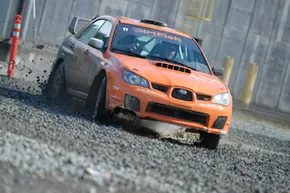
No one skids like a rally car driver. Travis Pastrana, Ken Block, all those crazy Finnish guys who seem to have been born on frozen lakes — they send the back end of those rally cars sliding around corners on purpose. Bonus points if they can get a rooster tail of mud, water, or snow to fly up behind them.
But even in a rally car, if that skid keeps going forever, the car is just going to go around in a circle and probably slam into a tree. That’s a terrible strategy for winning races. Rally drivers have to be able to get their cars out of the skids they create.
Forest Duplessis is the head instructor at DirtFish Rally School in Snoqualmie, Wash. We’ve all heard that you should “steer into the skid,” which Duplessis says sounds simple, but the problem is that people turn the wrong way.
Say you’re going around a turn to the right, and your back end starts to come around too far. This is called oversteer,by the way. The nose of your car is now pointed too far to the right, right? What you need to do is countersteer to bring the car back to the direction you were trying to go in the first place. In this case, you need to point the car a bit to the left to keep it in the street and not on the sidewalk.
Duplessis says the first step is to look where you want to go, and then make sure your hands agree with your eyes. If you need to make a little adjustment to the left, as in our example, then look a little to the left, where you would like your car to be. “The movement is quick and smooth,” Duplessis notes. “It’s smaller than most people would think.”
Of course, being a rally instructor, Duplessis also says “the more you get comfortable with it, the more you learn to appreciate oversteer.” Rally drivers work to apply the right amount of turn with the right amount of correction to keep the car in a state of controlled chaos while they basically steer with the rear of the car. As Duplessis says, “Embrace the slide.”
Doing Doughnuts with the LAPD
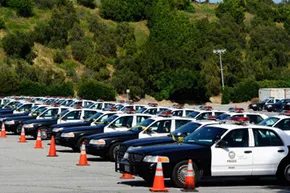

You’ve seen the footage. Los Angeles police chasing suspects at breakneck speeds, helicopters buzzing like angry hornets overhead. It’s a Hollywood staple because it’s visceral. But the LAPD doesn’t just hand keys to rookies and wish them luck. Officer Douglas Barnhart, the department’s driving instructor, says trainees spend three hours solely on skid control. Three hours. Doing doughnuts.
“Don’t look where you don’t want to go,” Barnhart cautions. “Like a tree or a pole.”
Most drivers are terrible at realizing they’ve lost traction until it’s too late. Modern traction control systems save us from our own ignorance by intervening early. But when those electronics fail or aren’t enough, your natural instincts actually work. You’re already looking where you want the car to go. Keep your eyes there. Your hands will follow.
Understeer: The Invisible Trap
There’s another skid the LAPD drills for. Understeer. This happens when you carry too much speed into a corner. The front wheels lose grip. The car plows straight ahead, ignoring your steering input. Think of a cop running a yellow light and realizing the turn isn’t happening.
Barnhart’s fix is counter-intuitive. To regain traction, you must straighten the wheels. Yes. Even if you’re staring down a building. You steer toward the obstacle. It sounds insane. But sliding tires generate no directional force. Rolling tires do. Once the tires stop sliding and start rolling, you can steer again.
The Two-Wheeled Terror
Now let’s take away two wheels. Motorcycles. Ray Pierce of the Team Oregon Motorcycle Safety Program knows this pain well. A rear-wheel skid on a bike usually isn’t about a wet road. It’s about using too much rear brake mid-turn.
Imagine you’re in a hot air balloon looking down at a rider. The bike leans into a curve. The rider yanks the rear brake. The front wheel keeps rolling straight. The rear wheel, locked or slowing disproportionately, steps out on the “high side.” Pierce calls it an old-timey dance move. It’s not. It’s a loss of alignment.
The solution? Release the rear brake. Let the wheel spin freely to regain traction. Don’t reapply it until you’re stable. Squeeze gently. If the bike snaps upright too fast, you’re flying over the handlebars. That’s the worst-case scenario.
Why Pros Still Pray
Pierce spends most of his time teaching avoidance. The best skid is the one you never enter. He admits even instructors aren’t immune. He recalled a recent incident on a go-kart track. He didn’t move the controls. He didn’t panic. He just hoped the rear end would stay under him as he wrestled the bike back to vertical.
“There was a lot of praying,” he says.
“There was a lot of praying,” says Ray Pierce.
It’s not just about muscle memory. It’s about trusting the machine. Cars have four points of contact. Bikes have two. The margin for error shrinks to nothing when the rear tire loses grip. You don’t fight the slide. You facilitate it. You let the mechanics do the work.
This isn’t theory. It’s physics. And physics doesn’t care if you’re in a Crown Victoria or a Honda CBR. It only cares if your tires are rolling or sliding.