

Harry Bradley didn’t just design cars. He lived them.
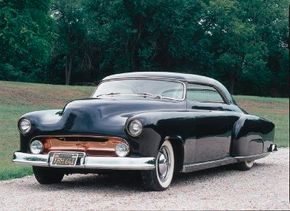
Before he became the legendary stylist behind some of General Motors’ coolest concepts and helped shape the look of Mattel’s Hot Wheels, he was a kid in La Jolla, California. He was hungry. And he had a 1951 Chevy Bel Air hardtop in his driveway.
This car is special. It’s known as the La Jolla. Not because of where it was built, but because it was the first custom car Bradley ever made. It was also his first car.
He bought it in 1954. He was still in high school. The deal came with a strict condition: keep it stock. No modifications.
That promise lasted about as long as it takes for a teenager to look at a Pinin Farina brochure.
“They had gotten to me — ‘they’ being Pinin Farina, Harley Earl, Joe Bailon, the Barris brothers. My parents didn’t have a chance against the likes of them.”
Harry Bradley, 1985
The parents lost. The car was going to change.
Bradley didn’t do half measures. He went to work on every single panel. It wasn’t a quick polish. It was a total transformation.
The hood was the first casualty. He dechromed it. Then he had his friend Herb Gary “pancake” it. Pancaking is a brutal process. You mold the metal into the body lines, then cut out a smaller, flatter piece from the top. It makes the hood sit lower and tighter.
He didn’t leave it manual. He rigged an electric motor with twin screw drives. Now the hood opened and closed with the push of a button.
The roof didn’t escape either. It was chopped about three inches. That’s significant. You lose headroom. You gain style.
The doors followed. Bradley straightened the upper lines. He reskinned them. The A-pillars were modified to match the new door shape. Custom one-piece glass went in each door. No more sliding windows. Just sleek, fixed glass.
The windshield area got tricky. He needed new lower moldings. He had them cast in lead. Then he chrome-plated them.
The sheetmetal around the backlight was replaced. He cut a piece from a 1949 Plymouth. He narrowed it. He sectioned it. It had to fit perfectly.
The windshield itself came from a 1953 Pontiac. It was cut to fit the new opening.
Front end work was just as intense. He frenched the headlights. That means burying them into the bodywork so they’re flush. No more chrome bezels sticking out.
He installed a 1949 Mercury grille opening. But the grille itself? He fashioned it from copper.
The bumper was smoothed. Guards were removed. A 1949 Chevy license plate guard went on.
It wasn’t a restoration. It was a reinvention.
Bradley proved he had the skills before he had the resume. This 1951 Chevy was the proof.
The La Jolla wasn’t just a car. It was a statement.
Who knew a high school kid could reshape steel so thoroughly?

Customizing the Rear and Side Profile
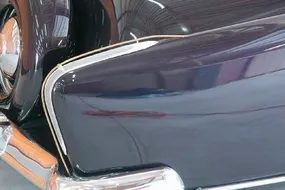
The rear end wasn’t just an afterthought. Harry pancaked the trunk lid to create a sleeker profile. He didn’t leave it bare. Instead, he tucked away a continental kit. To make the extension look intentional, he stretched the rear fenders out. The taillights got a custom treatment too. Hand-cut clear lenses replaced the stock red glass. The bumper itself? A swap from a 1952 Pontiac. It added a chunk of period-correct steel to the mix.
But the real showstopper on the flank was the rocker panel design. Most customizers of the era just cut the panels down. Harry and his brother Herb went different. They called them “floating” rockers. The method was clever. They cut new metal rockers. Then they cut 1.5-inch thick frosted-white Plexiglas to match the width. First came the plastic. Then the metal rockers were bolted over it.
“This created a more flowing line into the rear fenders.”
The result changed how light hit the side of the car. Harry didn’t stop there. He wired LEDs into the leading edge of those Plexiglas panels. At night, the rockers didn’t just reflect light. They glowed like lenses. It was subtle. Effective.
Handling and Powertrain Choices
Lowering a custom in the mid-century usually meant one thing: bad handling. Enthusiasts installed lowering blocks. The ride became stiff. The geometry went haywire. Harry wanted to avoid that penalty. He didn’t use blocks. He channeled the body.
He cut the frame rail ahead of the rear springs. This raised the rear end of the body by 3.5 inches relative to the suspension. The rear tires sat lower. The center of gravity dropped without sacrificing spring travel. Front suspension mods followed the same logic. Simple. Clean.
Under the hood sat a new 283-cid Chevy V-8. It was fresh. Reliable. The exterior wore a deep chocolate-ebony candy pearl. Dark. Glossy. It hid the metal work well.
Harry’s connection to the machine was physical as well as mechanical. Stricken with polio young, he couldn’t use standard pedals. Friend Floyd Martin built custom hand controls for the throttle and brakes. Harry drove it. He lived with it.
A 45-Year Relationship
This wasn’t a trailer queen. Harry owned the La Jolla for over 45 years. He drove it through college. Through family life. Through his career in automotive design. It was a constant. A tool. A companion.
In 1999, he sold it to Jack Walker. Jack was a noted custom car collector. He didn’t just buy the car. He worked with Harry to restore it. They made two changes. Bradley-approved modifications. The La Jolla remained a singular example of personal expression in a sea of cookie-cutter customs.
Harry’s hands were on the wheel for nearly half a century. That kind of ownership leaves a mark. You can’t replicate that patina with a restoration budget. The car remembers the miles. The candy pearl fades slightly in the sun. The Plexiglas yellows at the edges. It’s not perfect. It’s real.
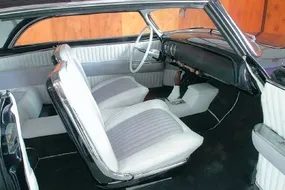
Harry took the reins on the interior, crafting a rolled-and-pleated design that felt anything but ordinary. Bob Sipes brought it to life with a color palette of crisp white and soft light lavender. It was a sharp contrast to the exterior. Jack had the body painted dark purple. He liked the shade so much he favored it back in the 1950s. Brown simply didn’t cut it for this build.
Once the paint dried and the upholstery was stitched, the car hit the circuit. It toured custom auto shows, turning heads wherever it parked. But the glory days didn’t last forever. Eventually, the machine retired from the spotlight. It now sits in Jack’s stable of historical customs. A preserved piece of automotive history.
Exploring Custom Car Culture
For those digging deeper into the roots of this scene, the lineage of hot rods offers context. Understanding the history of hot rods helps explain why builds like this matter. They aren’t just cars. They’re statements.
Profile Deep Dives
If you want more specifics on the legends of the street, custom car profiles provide the details. They break down the builders, the parts, and the stories behind the steel. Hot rod profiles do the same for the speed-focused side of the hobby. Each angle adds another layer to the narrative.
“Color choice defines the mood. Purple isn’t just a hue. It’s a history.”
The show circuit fades. The trophies gather dust. What remains is the car itself. Sitting quietly now. Waiting for the next eye to appreciate the pleats. The purple. The history.