



Long-haul truckers know the math intimately. They need to squeeze every mile out of every drop of diesel because their livelihood depends on it. The rule is simple: an aerodynamic trailer costs less to tow than a big, square box. But there is a problem. These rigs are packed tight. You are hauling sacks of flour, boxes of concrete, or enough kettlebells to outfit every gym in Los Angeles. You can’t just thin out the cargo.
So they optimize what they can. Gap fairings, rear fairings, and side skirts reduce wind friction. They stop the trailer from bouncing around like a greased eel. The payoff is real. A massive tractor-trailer can save around 800 gallons of fuel annually. That is enough gas for an average driver in San Jose, California, to cruise around town for an entire year.
Summer vacation changes the variables. You are not hauling freight. You are dragging a travel trailer behind a minivan with sugar-happy kids in the back. Here, aerodynamics takes a different shape.
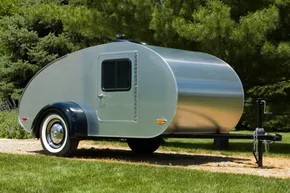
The teardrop trailer wins. Fat end behind the car, skinny end trailing away. It is the most efficient shape. If the trailer roof sits lower than the towing vehicle’s roofline, the air flows over both and swirls off the back. Clean. Efficient. These trailers are also lightweight. The engine does not have to work as hard. But shape alone is not magic. It is a combo of form, lightweight materials, and clever design.
Why Everyone Doesn’t Tow a Teardrop
So why does the boxcar still dominate the campgrounds? Simple. Some people like to stand up.
Even the cleverest teardrop design leaves the tail end awkward. You cannot walk front to back with dignity. In a boxy travel trailer, you can walk the length. Sure, you might whack your forehead on a bunk bed someone forgot to put away that morning. But you are upright.
In a teardrop, that rear space is sacrificed. It becomes storage. Or an exterior kitchen. Both are smart uses of dead space. Neither is a place to stash kids for the night. Seriously. Do not put your kids in the exterior fold-out kitchen. The trade-off is worth it for the fuel savings and ease of towing. But you lose the living space. You accept the curve. You drive lighter. You save gas. The kids scream. The balance shifts.