



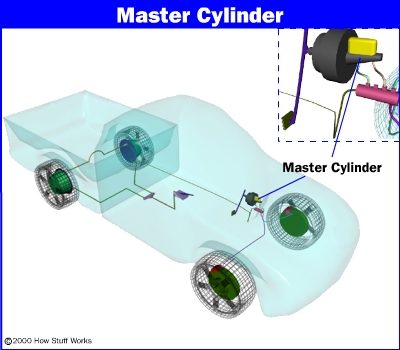
Modern braking systems are split into two separate hydraulic circuits. This isn’t just an engineering quirk. It’s a safety net. Each circuit controls two wheels. If one line sprays brake fluid onto the asphalt, you still have braking power on the other two wheels. You might lose half your stopping capability, but you won’t lose the car entirely.
At the heart of this dual-circuit setup is the master cylinder.
This component generates the hydraulic pressure that pushes brake fluid through the lines to every wheel. It’s a deceptively simple device. Inside, two pistons sit within a single cylinder body. They work in tandem but independently. If one side fails, the other keeps pushing. That redundancy is what makes the system relatively failsafe.
But pressure alone doesn’t keep you safe. You need feedback.
That’s where the combination valve comes in. This unit monitors the system. It alerts the driver if pressure drops or if one circuit fails before you even notice a change in pedal feel. It also balances braking force and prevents wheel lockup in certain conditions.
Understanding how these two parts interact explains why your brakes work when you need them most. Most modern cars use disc brakes on all four wheels, though some still use drum brakes on the rear axle. Regardless of the type, the hydraulic logic remains the same. The power brakes (vacuum assist) help you push hard, but the master cylinder translates that effort into actual stopping power.
Let’s look under the hood at the master cylinder.
The Master Cylinder Location and Function
You’ll find the master cylinder mounted directly on the brake booster, which sits against the firewall in the engine bay. It’s not hidden away. It’s bolted right where the brake pedal meets the vacuum assist unit.
The cylinder has two chambers. Each chamber connects to one of the brake circuits. When you step on the pedal, you push a rod into the master cylinder. The first piston moves, creating pressure in the primary circuit. Then the second piston moves, pressurizing the secondary circuit.
The master cylinder converts mechanical force from your foot into hydraulic pressure that stops the car.
Why two pistons? Because if one seal blows, the other can still generate enough pressure to bring the car to a halt. It’s not perfect. Stopping distance will increase. The pedal may feel spongy. But you stay in control.
The combination valve sits downstream, often near the firewall or along the brake line routing. It contains check valves, proportioning valves, and warning switches. It ensures that front and rear brakes engage at the right ratio. It also lights up the brake warning lamp if pressure differential occurs.
Without these components, anti-lock brakes (ABS) wouldn’t have the hydraulic foundation to pulse pressure. Power steering and ABS share the same fluid reservoir in many modern designs, but the master cylinder remains the primary source of braking force.
How does the piston move? It’s pushed by the brake pedal lever. The vacuum booster amplifies your foot pressure. The master cylinder then multiplies that force into hydraulic pressure. Simple physics. Complex execution.
The next section breaks down the internal mechanics of the master cylinder. How the pistons seal. How the fluid flows. Why leaks matter more than you think.
Where the Master Cylinder Hides and the Fluid Tank
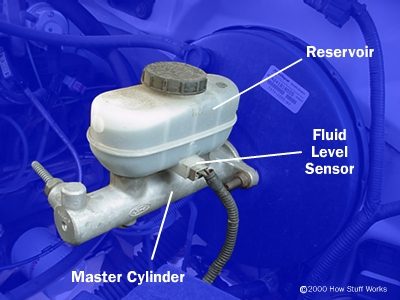
Most of the time, you will find the master cylinder bolted directly to the brake booster on the driver’s side of the firewall. It is the central hub where hydraulic pressure is born.
Look for the plastic reservoir sitting on top. That is the brake-fluid reservoir. It serves as the primary storage for the fluid that powers the entire system.
The electrical connection you see there is not there for power. It is a sensor. Its only job is to watch the fluid level. If the brake fluid drops too low, this sensor triggers a warning light on your dashboard.
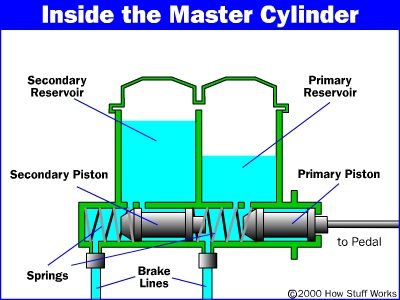
Inside the Dual-Circuit Master Cylinder
Look inside the housing. You are seeing two pistons and two springs. The setup is a dual-circuit design.
The Master Cylinder in Action
Step on the pedal. Linkage pushes the primary piston. Pressure builds in the cylinder and lines. Further depression forces the primary piston to push against the fluid between it and the secondary piston. That secondary piston compresses fluid in its own circuit. If everything works, pressure is identical in both circuits.
Something breaks. A leak appears in one circuit. That loop can no longer hold pressure.
Watch what happens when the first circuit fails. Pressure between the primary and secondary pistons vanishes. The primary piston slides forward until it contacts the secondary piston. The master cylinder now acts like a single-piston unit. The second circuit still functions. But look at the animation. You have to press the pedal much further to activate it. Only two wheels have pressure. Braking power drops sharply.
The Combination Valve
Most cars with front disc brakes and rear drum brakes use a combination valve.
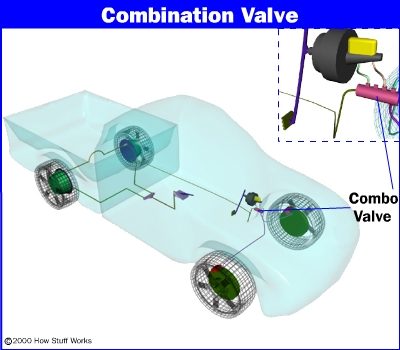
Finding the Combo Valve
You won’t find three separate metal blocks bolted to the frame rail anymore. Modern brake systems consolidate those functions into a single unit known as the combination valve. It’s a compact casting that does the heavy lifting for three distinct hydraulic roles. If you’re hunting for one, stop looking for individual metering or proportioning valves. Look for this single assembly.
The Metering Role
The metering valve is the first job inside the housing. It delays pressure to the front disc brakes. Why? Because disc calipers need more hydraulic force to compress their pads against the rotor than drum brake shoes need to expand into a drum. Without the delay, the front brakes would bite before the rears even start to drag. The valve holds back front pressure until the rear drums build enough fluid pressure to overcome their return springs. This keeps the car straight under hard initial braking. You’ll often find this valve integrated into the master cylinder on older GM trucks, or in a standalone block near the firewall on Fords.
The Pressure Differential Switch
The second function is safety. The pressure differential switch monitors the split between the front and rear circuits. If one line fails, pressure drops in that circuit. The switch detects the imbalance. It triggers the brake warning light on your dashboard. This isn’t just a courtesy. It tells you immediately if you’ve lost a brake line or if a wheel cylinder has blown out. You don’t need to feel the pedal spongy to know something is wrong. The light comes on. The valve physically moves a pin or plunger to close the electrical circuit when the pressures diverge beyond a set tolerance.
The Proportioning Function
The third role is the proportioning valve. This is where the math happens. As you brake, weight transfers forward. The front tires gain traction. The rear tires lose grip. If you sent full system pressure to the rears, they would lock up and slide. The valve restricts rear pressure once a certain threshold is reached. It keeps the rear brakes from overpowering the fronts. This is critical for stability. Without it, a light tap on the pedal could cause the back end to step out. The valve modulates rear pressure based on front line pressure, maintaining a safe ratio.
Where to Look
Locating this unit depends on the platform. On many import sedans from the 80s and 90s, it’s a small cylinder bolted directly to the firewall, near the master cylinder. You’ll see two input lines coming from the master and two output lines going toward the rear. On American muscle cars, it might be a standalone block mounted to the inner fender or frame rail. Check for a metal line that runs from the master cylinder into the valve, and lines that continue to the rear axle. If you see a wire connector on it, that’s your pressure differential switch.
“One casting. Three jobs. If you replace it, you’re replacing the metering, proportioning, and warning switch all at once.”
Why Replacement Matters
These valves wear out. The internal seals harden. The springs lose tension. If your brake pedal feels too high or too low, or if the warning light stays on after bleeding, the combo valve might be shot. You can’t adjust the metering delay or the proportioning ratio. It’s a fixed design. When it fails, you replace
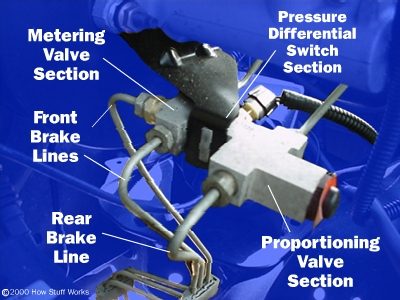
Why Your Rear Brakes Wait to Bite
The metering valve is a specific requirement for any vehicle running disc brakes up front and drum brakes in the back. It exists to solve a mechanical timing issue. Disc brake pads are already resting against the rotor. Drum brake shoes sit away from the drum.
Push the pedal.
The discs engage immediately. The drums lag behind. This creates a dangerous imbalance. You lose stability. The metering valve fixes this. It holds back pressure to the front discs. It waits for a specific threshold to be reached. Once that low pressure limit is hit, the drums finally make contact. Just before the discs.
This sequence keeps the car moving straight. Rear brake engagement first acts like a rudder. It stabilizes the yaw. Without it, the car would want to spin out under hard braking.
Detecting Hydraulic Failures
The pressure differential switch is the watchdog for your brake circuits. It contains a piston inside a cylinder. Each side of that piston faces a different brake circuit.
Equal pressure? The piston stays centered. No alarm.
Leak in one line? Pressure drops on that side. The piston shifts. It hits a switch. The red brake warning light on your dash illuminates. This is your early warning system for a failing master cylinder or a blown line. The wiring is visible on the valve body itself.
Stopping the Rear Wheels from Locking Up
The proportioning valve is there to manage weight transfer. Braking force capability depends on the load on the tire. More weight equals more grip.
When you slam on the brakes, the car dives forward. Weight shifts to the front axle. The rear gets light. If you applied equal pressure to all four wheels, the rear tires would lock up first. They would skid. Locking rear wheels leads to a spin. The proportioning valve prevents this. It restricts flow to the rear brakes.
Most cars also carry more static weight over the front due to the engine. The front brakes do more of the work anyway. The proportioning valve ensures the front gets the majority of the hydraulic force.
If the valve is set to a 70/30 split, you see the math clearly.
Front pressure: 1,000 psi.
Rear pressure: 700 psi.
The front stops the car. The rear helps without taking over. This ratio changes the dynamic significantly. You get predictable stopping distances. You avoid the nightmare of rear-end swing.
The proportioning valve doesn’t just reduce pressure; it balances the physics of deceleration.
Without these three sections working in unison, the combination valve is just a block of metal. The metering valve handles timing. The switch handles safety alerts. The proportioning valve handles load distribution. Fail one, and the whole system becomes unpredictable.
Where to Go From Here
If you want to dig deeper into how these hydraulic systems evolved, there are plenty of resources.
- How Anti-Lock Brakes Work : See how ABS interfaces with these valves.
- How Brakes Work : The foundational mechanics.
- How Disc Brakes Work : Specifics on pad and rotor interaction.
- How Drum Brakes Work : The internal mechanics of the rear end.
- How Power Brakes Work : Understanding the vacuum assist.
For historical context, check out Halting History: Brakes Then and Now. It shows the evolution from mechanical to hydraulic. InnerAuto: Braking System offers a broader look at the entire assembly.
If you are a DIYer, Automotive 101: Brake System Operation covers DOT fluid differences. This matters. Mixing fluids can destroy the seals in your master cylinder and combination valve.
For technical drawings, Master Cylinder Drawings and Rebuilding the Brake Master Cylinder are essential. You need to understand the source of the pressure to appreciate what the combination valve does with it. Professional Mechanics Online: Brakes and Auto.com provide current news on brake technology trends.
The combination valve is small. It’s often overlooked. But it’s the brain of the hydraulic distribution. Without it, modern braking geometry wouldn’t work. You’d be guessing.