


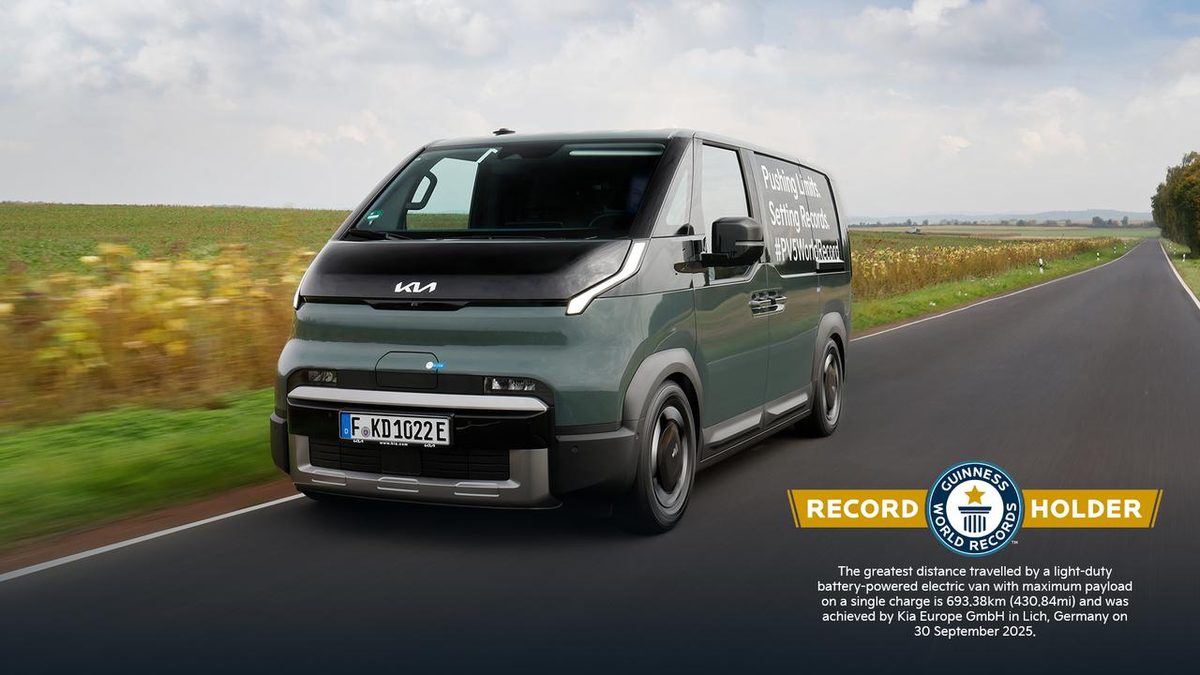
Kia is moving fast. The Korean automaker just added another entry to its trophy case, and this one has official backing. Guinness World Records has confirmed that the Kia PV5 Cargo achieved a new benchmark for energy efficiency. The test proves the brand’s tech is leading the pack, far exceeding typical European standards.
This performance puts pressure on established players. It gives compact vans from Stellantis and Renault plenty of reasons to worry.
PBV Platform Engineering
The PV5 Cargo isn’t a standalone design. It’s a derivative of the PV5 people mover, which hasn’t even launched in Europe yet. The vehicle stems from the Platform Beyond Vehicle (PBV) program. The goal here is simple: modularity. Kia wants a single chassis that can be reconfigured for various professional uses.
The record-breaking run wasn’t a light test drive. The cargo version went out on an open road. It carried a full load. That’s where the real stress test happens. The vehicle proved its electric powertrain can handle the weight and distance without faltering.
Efficiency as a Weapon
Why does this matter for the commercial van market? It’s not just about speed. It’s about staying power. By proving its electric system can maintain efficiency under heavy loads, Kia is signaling a shift in logistics.
Competitors are used to dominating the urban delivery space. This record challenges that assumption. If a Korean EV can outlast the competition on energy metrics, the rules of the game change.
Kia’s PBV program isn’t just about building vans. It’s about creating a flexible hardware platform that adapts to business needs.
The PV5 Cargo shows that range anxiety might be a thing of the past for professionals. If efficiency is this high, daily routes become less of a constraint. The question now is whether the supply chain can keep up with the demand for such capable, modular EVs.
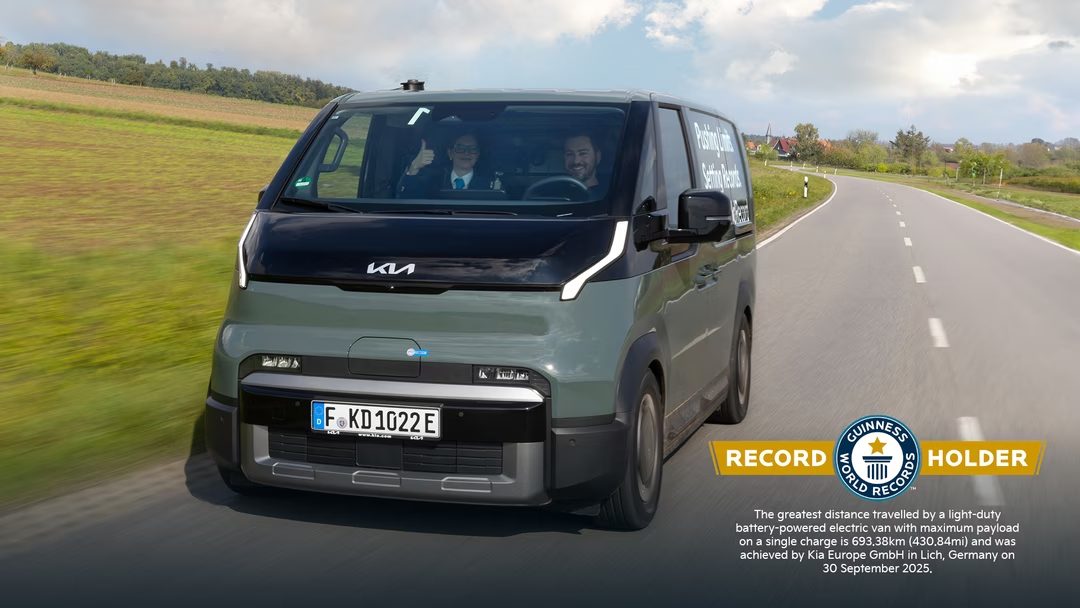
Breaking the 693-kilometer barrier with the PV5 Cargo
Most compact electric vans settle for a real-world range between 300 and 450 kilometers. The Kia PV5 Cargo just shattered that ceiling. It clocked 693.38 kilometers. That isn’t a lab simulation. It wasn’t done at a leisurely pace. The test happened on a real course, maintaining a constant speed. The van was loaded to its maximum capacity. Total weight sat at exactly 2,652 kilograms.
This proves Kia can deliver efficiency without sacrificing payload. It’s a direct shot across the bow of competitors who claim their electric vans are ready for professional use but can’t deliver the mileage.
How the PV5 Cargo achieved such high efficiency
The secret lies in the hardware. The PV5 Cargo is powered by a 71.2 kWh battery pack. That’s a significant capacity for a compact utility vehicle. But capacity alone doesn’t win range wars. The motor is optimized specifically for commercial duties. It prioritizes sustained torque and thermal management over sporty acceleration.
Why does this matter for fleet managers? Because range anxiety is the primary barrier to electrifying logistics. Most European electric vans struggle to break 450 kilometers under heavy loads. The PV5 Cargo does nearly double that. It demonstrates that zero-emission vehicles can handle long-haul, high-volume routes without requiring multiple charging stops.
Aligning with Kia’s 2030 electrification goal
This performance isn’t an accident. It fits squarely into Kia’s strategy to electrify its entire lineup by 2030. The PV5 Cargo serves as a technological showcase. It proves the brand can build vehicles that are:
- High-performing : Capable of outlasting competitors.
- Durable : Built for the rigors of daily commercial use.
- Economically viable : Lower operating costs per kilometer due to high efficiency.
The gap between concept and reality is closing. While other manufacturers are still tweaking their first-generation electric vans, Kia has already posted numbers that redefine the class. This isn’t just a media stunt. It’s a preview of what’s coming for commercial electric vehicles. The era of compromise between range and utility is over. Or at least, it should be.
Why this record changes the conversation
Fleet operators are looking at two metrics: payload and range. Usually, you have to give up one to get the other. Heavier batteries reduce payload. Lighter loads extend range, but that’s not how business works. The PV5 Cargo proves you don’t have to choose.
The question isn’t if electric vans can go this far. It’s why other manufacturers haven’t solved the efficiency puzzle yet. The technology exists. The battery density is there. The motor efficiency is proven.
As the industry races toward 2030, this record sets a new baseline. Buyers will start demanding these numbers as standard, not as outliers. The PV5 Cargo has drawn a line in the sand. Everyone else is now just catching up.