




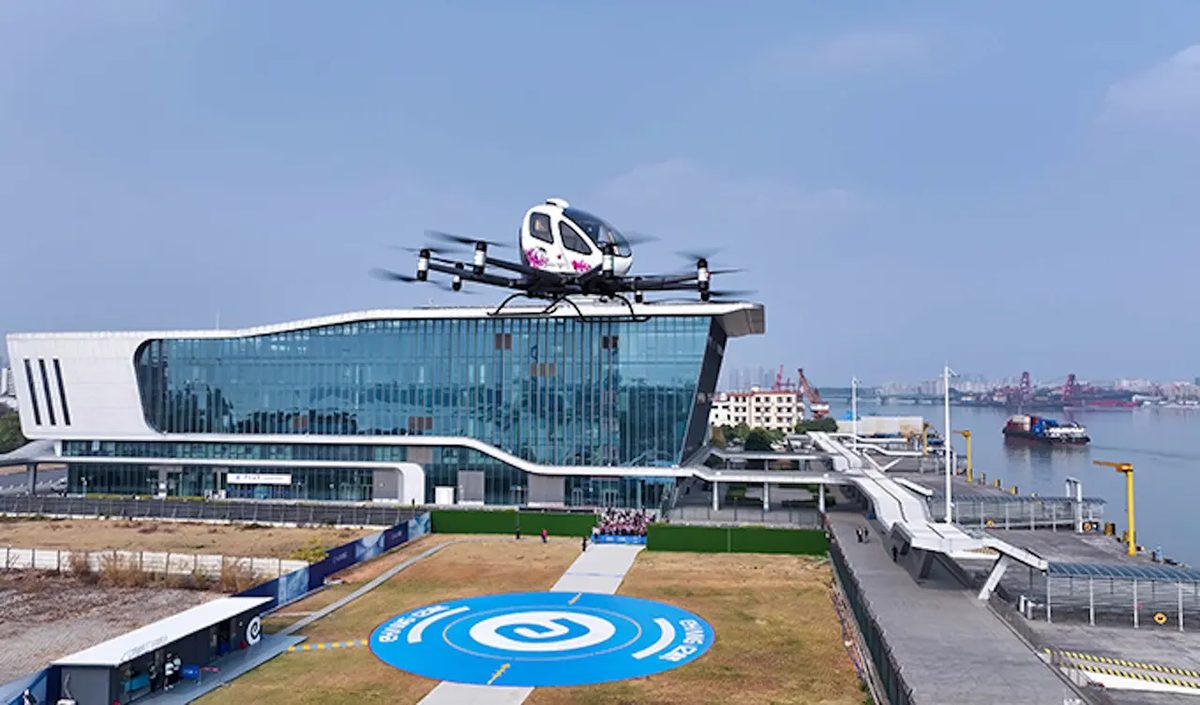
The full-scale launch of eVTOL in China has been officially approved. After nearly two years of testing and inspection by the Civil Aviation Administration of China, the EHang EH216-S has been certified. This is more than just a milestone. This is the starting gun for low-altitude commercial passenger transport in our country.
Tourist flights are limited, but Not Urban Taxis Yet
This is not a free-for-all. The initial stages are strictly limited. Flights will be limited to tourist routes around Guangzhou and Hefei. It is not yet possible to book a ride across a dense metropolis. This certificate binds the takeoff and landing of aircraft to one base. Travel between vertical airports is currently prohibited. This limitation is due to the fact that current services are limited to sightseeing loops and not point-to-point transit.
Two operators are preparing for its implementation: EHang General Aviation and Heyi Airlines. They have certificates to operate these machines for tourists. This is a controlled experiment in the sky.
EH216-S Specifications and Limitations
The EH216-S is a fully autonomous passenger drone. It has a carbon fiber composite frame and eight arms, each equipped with a rotor. This design prioritizes safety and redundancy over speed. It carries two passengers.
Navigation is based on a 5G connection to ground control stations. If the connection fails or something goes wrong, the ground operator takes over. The specs are modest but functional for short hops.
- Maximum speed: 130 km/h.
- Cruising speed: 100 km/h.
- Flight time: 21 minutes.
- Range: Approx. 35 km
- Battery charging time: 2 hours
EHang is already testing faster charging technology and extended battery solutions. The long-term goal is clear. The goal is to turn the EH216-S into a true air taxi service. The company is currently evaluating this broader capability with the Civil Aviation Administration of China, but is still in the evaluation phase.
Global contexts and Certification Hurdles
EHang plans to expand its certification to other regions in China. This is in stark contrast to the regulatory landscape in Western countries. Both the European Union Aviation Safety Agency (EASA) and the US Federal Aviation Administration (FAA) are moving much slower.
Take Volocopter for example. The company’s ambitions to Paris 2024 Olympics have collapsed. They partnered with ADP to deploy eVTOLs for event coverage. The European Union Aviation Safety Agency refused to approve the motors, citing vibration problems. In Europe and the US, the dream of seamless urban air mobility is still a distant. China has moving first in creating a regulatory framework, and others debate safety protocols.
Why is this important now?
The approval of EH216-S is important because it validates a specific type of eVTOL designs, including multi-rotor, autonomous and short-range. This proves that the technology is ready for commercial use, even if the application is niche. Focusing on tourism reduces risks and simplifies air traffic management.
Is this the beginning of the end of traffic jams? Probably not. But this is the beginning of something new. The airspace over Guangzhou and Hefei is currently regulated as a commercial zone. Other cities are also watch closely. We need to infrastructure will need to scale. Battery technology needs to improve. But the plane is flying.
The question arises: “can it fly?” “Where do we go next?” EHang aims for broader geographic approvals. Meanwhile, competitors in the US and Europe are still untangling certification knots. The lead is tangible. The gap is widening.