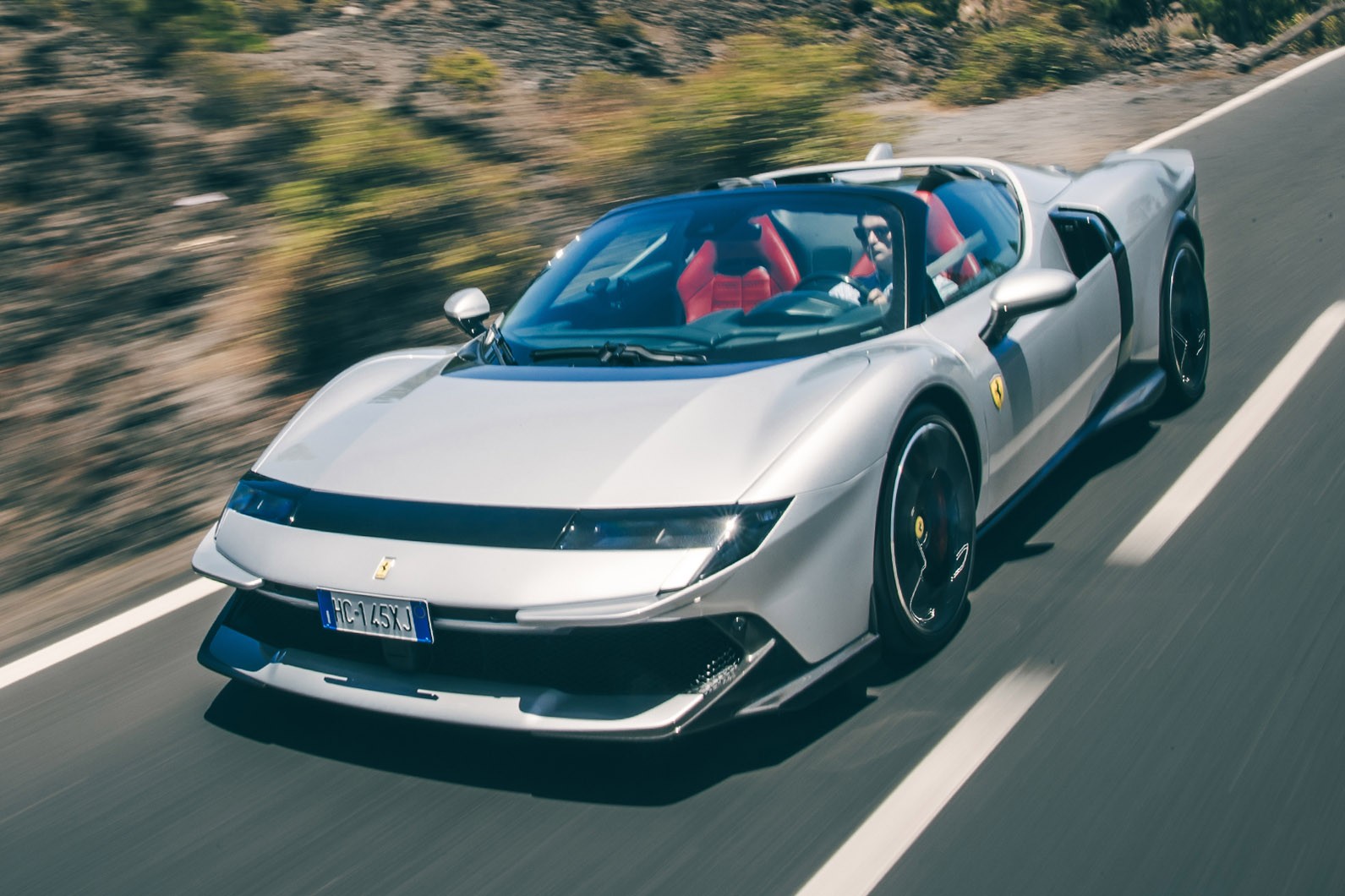
The name Testarossa. It carries weight. Seventy-one years of history. But until now, it never graced a drop-top. Maranello did crack the roofs off a few for cash-heavy clients in the Miami Vice era. This, however, is different. This is the first real production attempt to marry that legend with a retractable hardtop.
You pay a premium. About £30k extra over the coupé version. For that, you get a roof that folds itself away in fourteen seconds at speeds up to 28 mph. Cinematic. Choreographed. And because this is the 849, the tech is sophisticated. An electric sliding rear window manages wind and noise instantly. No fuss. Just clean air.
Storage space remains irrelevant in both forms, but the Spider changes visibility dynamics slightly. The stowed roof stays flush. It doesn’t stick out. You still need the rear camera to park, obviously. You are sitting behind a massive powertrain and some fragile carbon fiber that will hate being touched by a parking bollid. But the roof tucks neatly, hiding in plain sight.
Getting in involves a slight athletic commitment. You have to achieve that classic “bum-on-the-floor, feet-by-the-front-axle” seating position. The open top helps the maneuver slightly. But the big news for enthusiasts? The chassis rigidity. Ferrari claims zero loss. The weight gain is miniscule—just 30 kg. That is not a compromise. That is a miracle of engineering.
“Ferrari claims zero loss in torsional rig… a pretty minuscule weight gain.”
Silhouette preserved means aero efficiency preserved. Buffeting is minimal. You can drive with the top down at high speed without feeling like the wind is trying to fold you. It feels intentional. Natural. Ferrari execs wouldn’t give an exact sales split for the coupé vs. Spider mix, but a 50/50 balance is the new reality for the 849. Buyers want the open experience.
Hybrid Heart, Electric Brain
Power comes from an evolved plug-in hybrid V8. The combustion engine pushes 819 bhp. The electric system adds another 217 bhp. Combined: 1036 bhp. 641 lb-ft of torque. It is obscene. The setup uses two radial-flux motors on the rear axle. Each drives a wheel through its own transmission. That means fully asymmetric torque vectoring. Precise. Aggressive.
Then there’s the axial-flux motor between the engine and gearbox. It works like an F1 car. It acts as a generator to recharge the battery or dumps power into the mix under load. The 7.45 kWh battery cannot accept DC fast charging. However, drive calmly in Qualifying mode using just the engine, and it recharges fully in just a few miles.
This gives you around 15 miles of pure electric range. It sounds silly, doesn’t it? Choosing to turn off the V8. Leaving the house in silence. Starting the noise only when you hit the winding roads you love. There is wisdom in that choice. City driving becomes a stealth mission.
Ferrari insists the Spider isn’t just the coupé minus a roof. It’s an enhancement of the drama. The audio hits you differently without metal shielding the exhaust note. And yet… it’s not quite as visceral as you’d expect.
The flat-plane crankshaft delivers stupendous performance. But the sound is clinical. Sanitised. It barks on start-up. Settles into a burble that feels more expensive than emotional. It doesn’t have the soulful boom of old V8s. If we’re being honest, it sounds more like a superbike than a traditional grand tourer. Not a criticism, necessarily. A characteristic trade-off of the engineering priorities here.
“This is not an especially soulful engine relative to Maranello’s more aurally impressive powerplants.”
It does sound incredible when pushed. Hit 8,300 rpm on a mountain pass. The shift lights flash angrily. The turbochargers whine. The soundtrack becomes a race-flavoured shrieking that spirals around your cockpit. Downshifting triggers that metallic “whub-whub” of the eight-speed dual-clutch box. Deceleration feels almost as engaging as acceleration.
With the roof up in thick fog, the sound becomes muffled. In tunnels, the echo adds a layer of theatricality. A hollower timbre. More crackling and popping. It’s intoxicating. But purists might crave more. Perhaps a rawer SF90 XX-style exhaust in the future will provide the visceral punch this car craves but slightly misses.
Handling Dynamics Without the Drama
The dynamic parity claims are true. Raffaele de Simone, Maranello’s chief driver, would struggle to spot differences between the Spider and the fixed-roof model on public roads. The steering rack is sharply geared but never frantic. It retains heft. Communication remains crisp. You feel connected.
At over 1.7 tonnes, the precision is startling. The electric rear motors assist heavily here, pulling the car tightly into apexes. There is no artificial feel. The torque vectoring works seamlessly to boost agility. Even on public roads where full track speeds aren’t feasible, the car feels eager and responsive.
Comfort hasn’t suffered. We took this beast to Tenerife. The mountain roads are mostly pristine, but the rough patches tested the adaptive Magneride dampers. The car dispatched crumbly sections with surprising composure. No excessive crashing or thudding. It manages bumps with a maturity that belies its supercar pedigree. For extra comfort, a dedicated “bumpy road” mode slackens the dampers significantly. It softens the edge against potholes without sacrificing the driving feel.
There’s still work to be done on the soul, maybe. The tech is flawless. The performance is world-class. The sound is great, just not legendary. But as a way to drive the 849? It might actually be better open. The drama of it all… that’s the real story here. And that story is just beginning to be told in the wind.