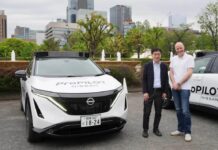
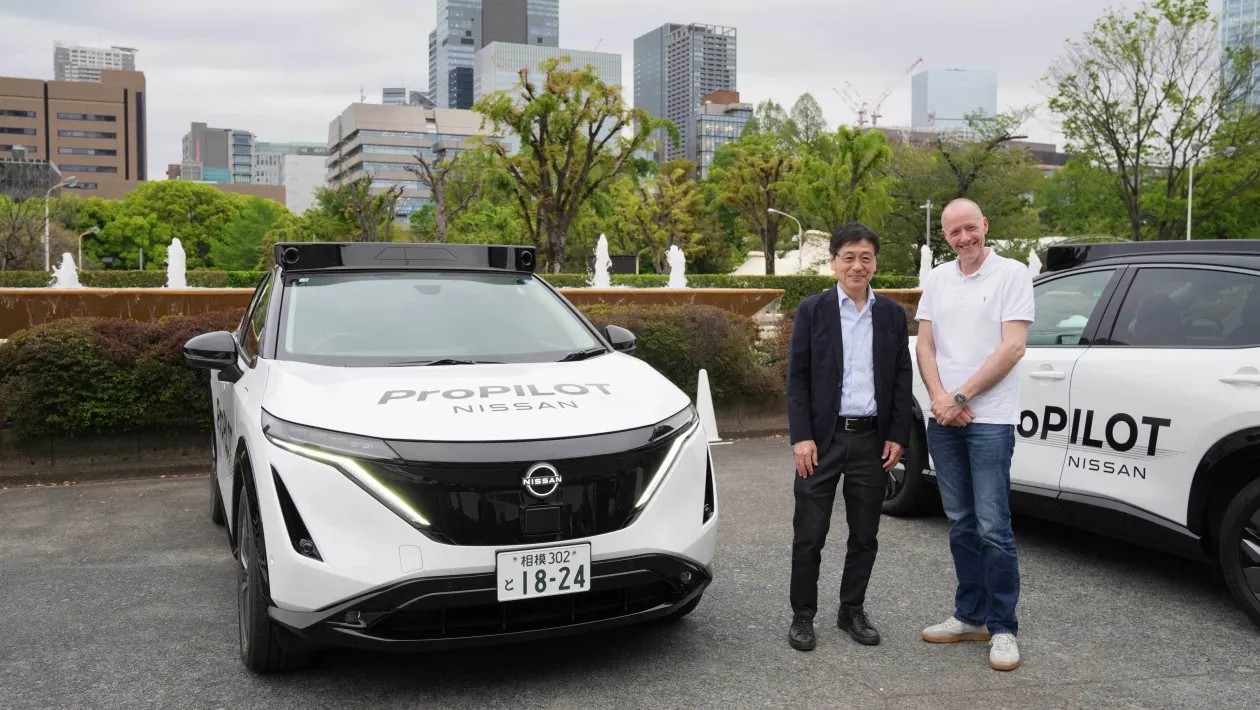
Navigating a blind right turn across three lanes of heavy Tokyo traffic is a high-stress maneuver for even the most seasoned drivers. Yet, in a recent demonstration, Nissan’s electric Ariya SUV performed the maneuver seamlessly—without a human touching the steering wheel, throttle, or brakes.
This isn’t just a driver-assist feature; it is a glimpse into the future of end-to-end autonomous driving, powered by a sophisticated collaboration between Nissan and British AI start-up Wayve.
The Brain Behind the Wheel: AI vs. Human Experience
Unlike traditional cruise control systems that rely on rigid code, Nissan’s third-generation Pro Pilot system utilizes an AI model trained on millions of hours of driving footage.
Tetsuya Iijima, Nissan’s Head of Automated Driving Tech, argues that the AI actually possesses a superior “understanding” of the world compared to humans. While a human driver relies on a lifetime of singular experiences, the AI’s knowledge is built from a massive, compressed dataset of safe driving maneuvers.
“My singular experience is compressed inside my brain. Even if I’m old, [the AI’s] knowledge is bigger, deeper, and it always concentrates on a 360° driving view. So yes—it is [a better driver].” — Tetsuya Iijima
The Sensory Suite: How the Ariya “Sees”
To replicate and exceed human perception, the prototype utilizes a multi-layered sensor approach:
- The Core (Cameras): Eleven cameras provide the primary “eyes” for the Wayve AI brain. These are essential for interpreting the 3D world and road structures.
- The Insurance (LiDAR): A LiDAR sensor mounted on the roof acts like high-powered binoculars, scanning for hazards up to 300 meters away. This is critical for safety in low-light conditions where cameras might struggle.
- The Perimeter (Radar): Corner radars assist with proximity detection and regulatory compliance.
- The Map (Digital Intelligence): The system uses Mapbox for turn-by-turn navigation and real-time speed limit guidance, allowing the car to navigate even in uncharted areas.
The “Level” Dilemma: Technology vs. Regulation
A critical distinction emerged during the test: the gap between what a car can do and what it is allowed to do.
While the Ariya demonstrated the ability to navigate complex urban environments without intervention—a hallmark of Level 4 autonomy (high automation)—it remains classified as Level 2 (partial automation).
This distinction is not technical, but regulatory. Even if the technology is “better than a human,” society and lawmakers are not yet ready to assign full liability to machines. This creates a bottleneck for the industry; as seen with Audi’s previous attempts at Level 3 highway driving, even when a manufacturer accepts liability, getting the systems approved for mass use is a massive hurdle.
The Road Ahead: Challenges to Mass Adoption
Nissan plans to bring this technology to customer vehicles, starting with the Japanese Elgrand MPV in 2027. However, several hurdles remain before autonomous driving becomes a standard feature in your driveway:
- Localization: During testing, the AI struggled initially with Japanese traffic signage because its foundational training was based largely on London streets.
- Hardware Packaging: Engineers are still determining how to integrate these heavy sensor suites (LiDAR, cameras, etc.) into a sleek, consumer-friendly design.
- Affordability: The cost of high-end sensors and the “Software Defined Vehicles” required to process them must come down significantly to reach the mass market.
- Liability: The legal framework for who is responsible during an accident remains unresolved.
Conclusion: Nissan’s Pro Pilot 3.0 proves that AI can match, and perhaps exceed, human driving competence in complex urban settings. However, the transition from a high-tech prototype to a consumer reality will depend less on the “brain” of the car and more on the willingness of regulators to redefine the rules of the road.