

The European Union is exploring a new class of ultra-affordable electric vehicles, and Japan’s Nissan Sakura—a “Kei” car—is serving as a key model. This small, efficient EV could reshape how Europeans think about urban transportation, potentially filling a crucial price gap in the market and shielding local manufacturers from cheaper imports.
The Rise of Kei Cars: A Japanese Success Story
Kei cars originated in post-war Japan as a way to make personal transport accessible. Strict regulations on engine size, dimensions, and power output keep costs down while maintaining functionality. The result is a thriving automotive niche, with the Sakura being one of the first all-electric options. These rules are now under consideration in Europe as a way to encourage low-cost EV production, potentially limiting vehicle size, power, and favoring local manufacturing.
Why This Matters Now
The EU’s interest in Kei-style regulations isn’t accidental. The push for cheaper EVs is driven by the need to compete with increasingly affordable foreign models and address the gap in the market for vehicles costing between £10,000 and £15,000. By streamlining regulations and encouraging local production, Europe could create a more sustainable, accessible EV ecosystem.
The Nissan Sakura: A First Look
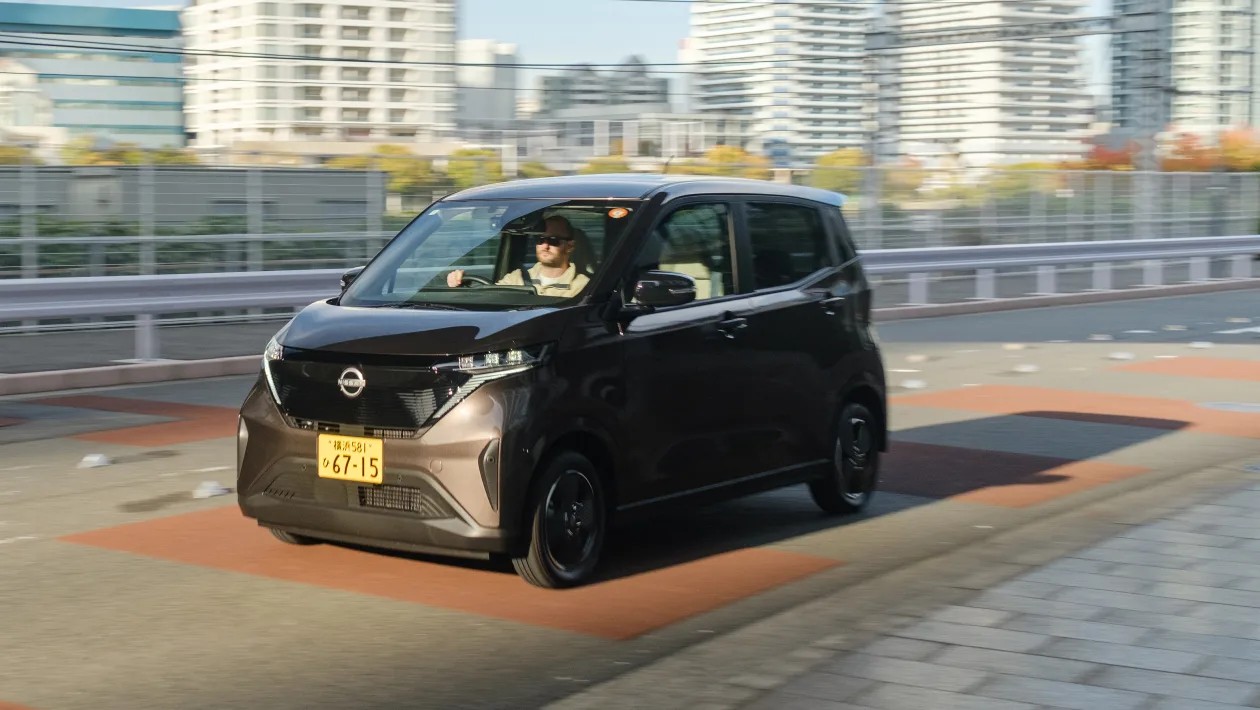
The Sakura embodies the Kei car philosophy: small, efficient, and surprisingly practical. Its dimensions are tightly controlled—maximum length of 3.4 meters and width of 1.48 meters—making it ideal for congested city streets. Despite its compact size, the upright design maximizes interior space, offering legroom comparable to larger cars. The Sakura’s tall shape also accommodates an under-floor battery pack without compromising headroom.
This packaging efficiency is further enhanced by the use of electric motors, which are smaller and require fewer components than traditional engines. Modern by-wire controls for pedals and steering also improve the design’s flexibility.
Driving Experience: Surprisingly Capable
The Sakura’s narrow width is immediately noticeable, making it easy to navigate tight spaces. The dashboard layout is minimalist, with controls grouped near the driver’s knee rather than following typical European design trends. Despite its size, the car offers generous leg and headroom in the second row, and the tall boot provides ample storage.
The electric powertrain delivers quick acceleration—63 horsepower with 195 Nm of torque—making it surprisingly agile in urban environments. The Sakura’s regenerative braking is smooth and powerful, similar to other modern EVs. While the 20 kWh battery limits the range to around 112 miles, this is sufficient for most city driving.
Is This the Future of Urban Mobility?
The Nissan Sakura demonstrates that small, inexpensive EVs can be both practical and enjoyable to drive. The Japanese have long understood the value of efficient, no-nonsense transportation, and the Kei car concept proves that less can indeed be more.
The EU’s consideration of similar regulations suggests a growing recognition of this approach. A Kei-style EV could fill a vital niche in European markets, offering affordable, sustainable mobility for urban and rural communities alike. The Sakura isn’t just a car; it’s a case study in how to make electric transportation accessible to everyone.