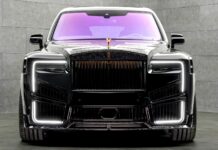


The Rolls-Royce Cullinan is engineered for discretion, luxury, and understated power. Mansory, the German aftermarket specialist known for extreme automotive customization, has released a version that deliberately shatters those conventions.
Debuting at the Top Marques Monaco event, the Black Badge Emperor Signature is not a refinement of the original SUV but a radical reinterpretation. It signals a clear divergence from Rolls-Royce’s traditional ethos, targeting buyers who prioritize visual aggression and exclusivity over the brand’s hallmark elegance.
A Facelift Defined by Aggression
The transformation begins with the exterior. Mansory has stripped away the Cullinan’s smooth, flowing lines in favor of a widebody stance and sharp, angular components. The front fascia features a redesigned bumper, blacked-out air intakes, and extended LED daytime running lights that give the vehicle a more menacing gaze.
The body kit is extensive, incorporating:
– Flared front and rear wheel arches
– A new hood panel
– Vertical spoilers mounted on the front quarter panels and behind the rear doors
These elements are not merely aesthetic; they are designed to make the SUV appear wider, lower, and more planted, despite the vehicle’s inherent height and weight.
Forged Carbon Over Class
The most striking feature of the Emperor Signature is its material choice. Mansory has covered significant portions of the body in exposed forged carbon fiber. This includes the hood, wheel arch extensions, side skirts, rear spoiler, and rear diffuser.
Forged carbon is a high-performance material often associated with hypercars like McLaren’s, known for its unique woven pattern and lightweight properties. Applying it to a Rolls-Royce creates a stark visual contrast. Where Rolls-Royce typically uses polished chrome or matte black accents to convey wealth, Mansory uses industrial-grade carbon to convey technical intensity.
The use of forged carbon on a vehicle designed for comfort rather than speed highlights a growing trend in luxury customization: the merging of hypercar aesthetics with grand tourer platforms.
The Orange Accent Paradox
To break up the monochrome dominance of black and carbon, Mansory has introduced dark orange accents. This color appears on:
– The Spirit of Ecstasy hood ornament
– Pin stripes running along the vehicle’s flanks
– Badging
– Aero discs on the wheels
The inclusion of aerodynamic wheel discs on an SUV is particularly notable. While these discs reduce drag on high-speed sedans or supercars, their functional benefit on a Cullinan—which already has the aerodynamic profile of a large box—is negligible. Here, they serve purely as a visual statement, reinforcing the “performance” narrative even if the physics don’t fully support it.
Interior: Carbon Continues Inside
The interior treatment mirrors the exterior’s intensity. Mansory has replaced traditional leather and wood veneers with black Alcantara, accented with orange contrast stitching and piping. Carbon fiber trim is scattered throughout the cabin, ensuring that the aggressive theme persists even when the vehicle is stationary.
This approach suggests that the target audience for the Emperor Signature is not looking for a relaxing sanctuary but a bold display of automotive individuality.
Conclusion
The Mansory Black Badge Emperor Signature is a deliberate departure from Rolls-Royce’s core identity. By applying hypercar materials and aggressive styling cues to a luxury SUV, Mansory has created a vehicle that prioritizes visual impact over traditional refinement. It raises questions about the boundaries of luxury customization: is exclusivity defined by heritage and taste, or by sheer audacity and material intensity?