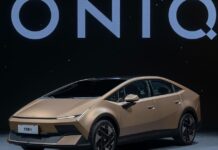


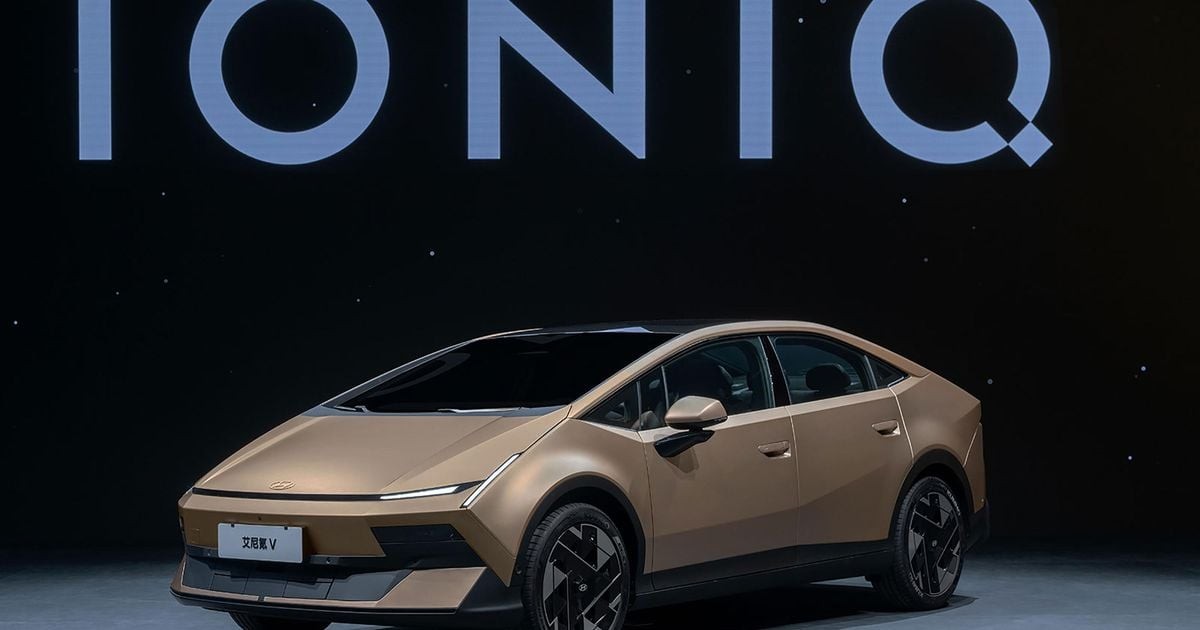
The automotive landscape is shifting rapidly as Hyundai attempts to pivot its struggling Chinese operations into a global export hub. The Hyundai Ioniq V, a sleek, China-developed electric vehicle unveiled at the 2026 Beijing Motor Show, is currently under feasibility study for export to markets including Australia, the Middle East, Latin America, and the wider Asia-Pacific region.
This potential expansion comes against a backdrop of severe sales declines for Hyundai in China, prompting the automaker to adopt an “In China, For China, To Global” strategy. The goal is clear: leverage local manufacturing capabilities and design trends to capture international markets where trade barriers are lower.
🌏 Why Australia? The Tariff Factor
The absence of Europe and the United States from the initial list of potential export markets is not an oversight—it is a direct response to aggressive trade protectionism.
- Europe: Since 2024, the European Union has imposed tariffs of up to 35.4% on EVs manufactured in China. While some manufacturers have negotiated exceptions through price guarantees and sales quotas, the barrier remains significant for mass-market vehicles.
- United States: The U.S. has effectively banned most Chinese-made EVs with a 100% tariff, leaving only ultra-luxury niche models like the Lotus Eletre viable.
In contrast, Australia and other emerging markets offer a more accessible entry point. For Hyundai, exporting the Ioniq V to these regions is a strategic necessity to offset the massive slump in domestic Chinese sales.
🚗 Design and Technology: A New Breed of Sedan
Despite its name echoing the popular crossover Ioniq 5, the Ioniq V is technically a sedan. It features a dramatically styled, aerodynamic silhouette that draws comparisons to the Toyota Prius, but with a more aggressive, futuristic edge.
Key Specifications:
* Dimensions: 4,900mm long, 1,890mm wide, 1,470mm tall.
* Wheelbase: 2,900mm (50mm shorter than the Ioniq 6, despite being 45mm longer overall).
* Range: Claimed 600km under the CLTC testing cycle.
* Powertrain: Details remain scarce, but it is built on Hyundai’s latest EV architecture.
The interior embraces a minimalist aesthetic, dominated by a 27-inch 4K touchscreen. Driver information is projected via a Horizon Head-Up Display (HUD), positioned at the base of the windscreen for optimal visibility.
Under the hood of the software, the vehicle is powered by a Qualcomm Snapdragon 8295 chip. This high-performance processor manages the “Smart AI” voice assistant and complex human-machine interactions. Advanced driver-assistance systems (ADAS) are supplied by Momenta, a leading autonomous driving technology provider, suggesting a high level of autonomous capability.
📉 Reviving Beijing Hyundai
The Ioniq V is not just a new car; it is a lifeline for Beijing Hyundai, the joint venture between Hyundai and Chinese manufacturer BAIC. The partnership has faced a precipitous decline:
* 2018 Peak: ~350,000 vehicles sold per quarter.
* 2026 Q1: Just under 27,000 vehicles sold.
To reverse this trend, Beijing Hyundai has committed ¥8 billion (A$1.6 billion) to develop a new lineup of electric vehicles (EVs) and extended-range EVs (EREVs). The company aims to reach annual sales of 500,000 units, with the Ioniq V serving as the flagship model in this revival effort.
🔮 Context: The “China-First” EV Wave
The Ioniq V represents a broader trend in the automotive industry: China as a design and manufacturing leader for EVs.
While the Ioniq V is the first model in the Ioniq series developed specifically for the Chinese market, it is not the first Hyundai EV to follow this path. The Hyundai Elexio, which launched in Australia earlier this year, was also developed with Chinese market dynamics in mind. This signals a strategic shift where Hyundai leverages China’s rapid EV innovation and cost efficiencies to compete globally, particularly in markets less burdened by protectionist tariffs.
The Bottom Line: The Hyundai Ioniq V is more than just a new electric sedan; it is a test case for Hyundai’s ability to turn a domestic failure into an international opportunity. If successful in Australia and other export markets, it could redefine how global automakers utilize their Chinese operations in an era of fragmented trade policies.