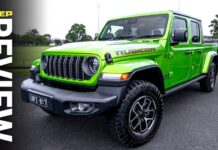



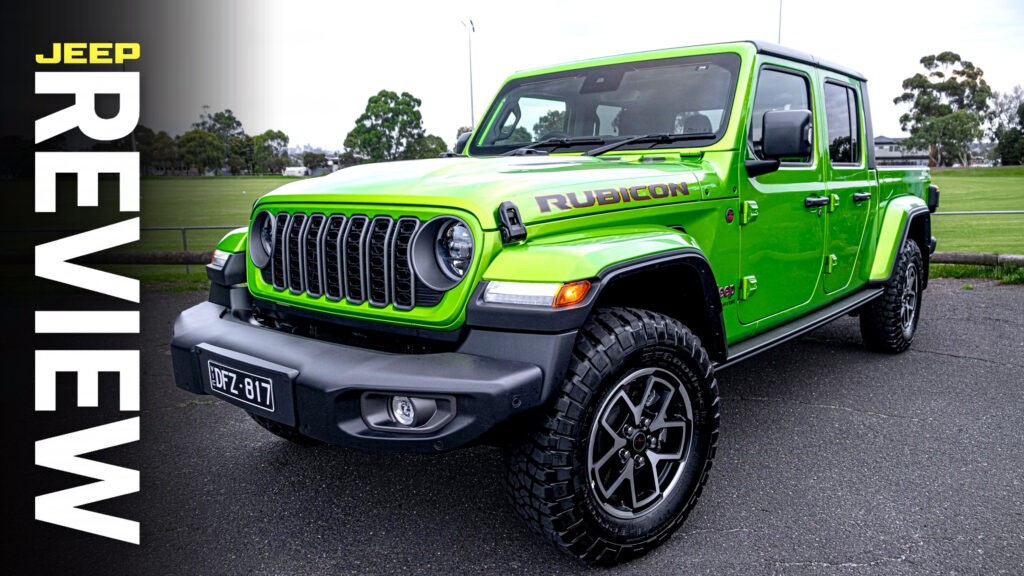
The Jeep Gladiator occupies a unique, somewhat contradictory niche in the automotive world. While most mid-sized pickup trucks are marketed as versatile tools for work and family life, the Gladiator is designed for the wilderness. It inherits the DNA of the Wrangler—removable roof panels, rugged axles, and extreme off-road capability—but stretches that DNA into a long-wheelbase pickup format.
However, a gap exists between what the Gladiator can do and what most owners actually need it to do. For many, this truck is a daily driver navigating traffic and grocery runs, rather than a mountain climber tackling rocky passes.
A Singular, Rugged Offering
In markets like Australia, Jeep has simplified its lineup for 2026. The Gladiator is now exclusively available in the Rubicon configuration. This means buyers no longer have the option of a more road-oriented, budget-friendly version; if you want a Gladiator, you are buying a dedicated off-roader.
Powered by the reliable but aging 3.6-liter Pentastar V6, the Rubicon is priced at approximately AU$82,990 ($56,800) before on-road costs. When compared to rivals like the Ford Ranger Raptor, the Gladiator faces a tough challenge: the Raptor offers significantly more power and a more advanced suspension system for a relatively small price premium.
Interior: Old-School Charm vs. Modern Tech
The cabin is a study in contrasts. Jeep has updated the interior with a much-needed 12.3-inch infotainment display, which features wireless Apple CarPlay, Android Auto, and dedicated off-road telemetry.
Yet, the rest of the interior remains stubbornly traditional. In an era where many manufacturers are moving toward minimalist, screen-heavy cockpits, the Gladiator remains a bastion of physical buttons. While this might feel “dated” to some, it offers a tactile advantage: you can operate climate controls and drive modes by feel without taking your eyes off the road.
Key Cabin Observations:
– Ergonomics: The high entry point requires taller drivers to duck to avoid the roof pillars.
– Space: Thanks to its massive wheelbase, rear legroom is exceptionally generous.
– Comfort: While the build quality is high, the seats lack the lateral support needed for long journeys.
Capability vs. Practicality
The Gladiator’s greatest strength is also its greatest weakness. Its off-road credentials are undisputed. With the Rock-Trac 4×4 system, locking differentials, and an electronic sway-bar disconnect, it can conquer boulders, steep inclines, and water crossings of up to 800mm.
However, this “go-anywhere” hardware compromises its utility as a standard pickup:
- Towing and Payload: The Gladiator’s towing capacity (2,721 kg) and payload (693 kg) lag significantly behind competitors, many of which can tow closer to 3,500 kg.
- On-Road Refinement: The 33-inch BFGoodrich off-road tires and solid axles result in a “wayward” steering feel and increased road noise at highway speeds.
- Dimensions: Its extreme length makes it a handful to maneuver on tight, winding trails or in crowded urban environments.
The Verdict: Buying with the Heart
The Jeep Gladiator is not the most logical choice on paper. It is thirstier than its peers, carries less weight, and is less refined on the pavement. Yet, it offers an experience no other pickup can replicate: the ability to strip away the roof and doors to truly connect with the environment.
Despite its aging platform, sales remain steady in many regions, proving that there is a persistent demand for a vehicle that prioritizes adventure over pure utility.
Conclusion: The Jeep Gladiator Rubicon is a specialized tool. If you prioritize towing capacity and fuel economy, your head will tell you to look elsewhere; but if you crave the freedom of open-air adventure, your heart will lead you straight to a Jeep.