


The history of the Japanese motorcycle industry is a story of evolution from budget-conscious replicators to global innovators. Initially, Japanese manufacturers gained a foothold by offering something the European and American markets lacked: unshakeable reliability at an affordable price. While breakdowns were once considered an accepted part of the motorcycling experience, the Japanese changed the standard, making mechanical dependability a core requirement rather than a luxury.
Over time, these manufacturers moved beyond mere imitation. They developed distinct identities—from the touring dominance of the Honda Gold Wing to the high-speed thrills of Kawasaki’s two-stroke era. However, within the hyper-competitive 600cc supersport segment, one model managed to do something unique: it broke the established rules to create a bike that was as capable on the street as it was on the track.
Breaking the 600cc Mold
For decades, the middleweight supersport class was governed by strict racing regulations. These rules dictated a specific formula: an inline-four engine with a displacement just under 600cc. This resulted in a sea of nearly identical motorcycles that prioritized peak power at the expense of real-world usability.
Kawasaki took a different approach. In 2002, they recognized that a pure race machine isn’t always a practical road bike. By increasing the displacement to 636cc, Kawasaki provided a significant boost in torque, making the bike much more responsive in everyday riding conditions. While competitors stuck to the 599cc norm, the ZX-6R offered a “middle ground” that provided better performance across the entire rev range.
Engineering for the Track and the Street
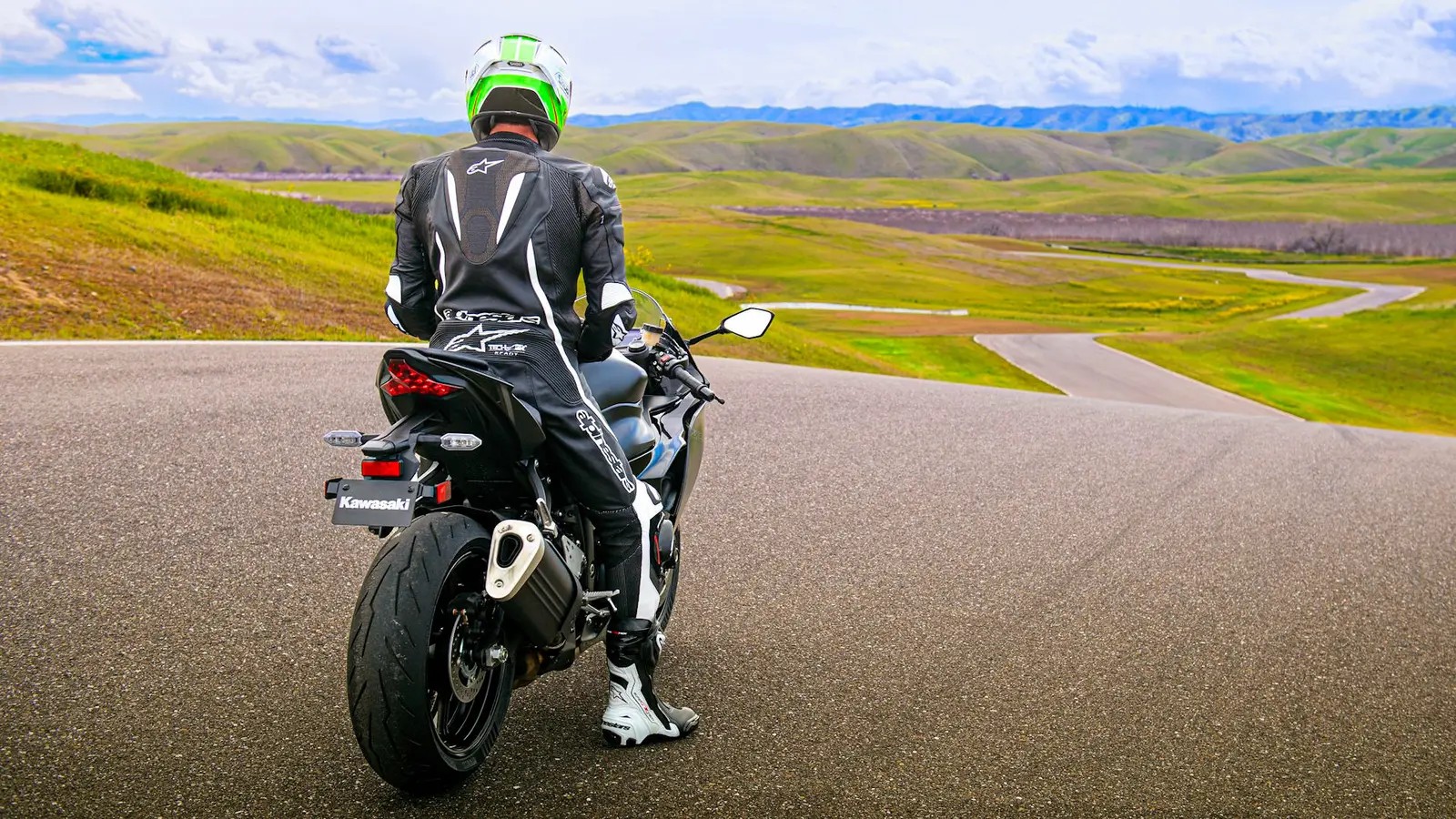
The Ninja ZX-6R remains a formidable precision tool, largely due to its traditional, high-quality mechanical foundation.
- The Engine: The current iteration produces 127 horsepower at 13,000 RPM and 52.1 lb-ft of torque, delivered through a six-speed gearbox.
- The Chassis: It utilizes a proven aluminum perimeter frame paired with high-end suspension, including 41mm inverted Showa SFF-BP forks and a fully adjustable Uni-Trak rear shock.
- Handling: With a compact wheelbase and a weight of approximately 436.6 pounds, the bike is designed for razor-sharp agility.
- Braking: The setup features dual 310mm semi-floating petal discs with radial monobloc four-piston calipers, providing the stopping power necessary for aggressive riding.
The Modern Dilemma: Performance vs. Technology
Despite its mechanical prowess, the ZX-6R faces a growing challenge: the digital divide. As motorcycles become increasingly “smart,” the Ninja remains a relatively analog machine.
While it includes essential modern safety features like traction control, an assist/slipper clutch, and intelligent ABS, it lacks the sophisticated electronics found in newer competitors. Because it uses a cable-actuated throttle rather than a “by-wire” system, it lacks ride modes and a six-axis IMU, meaning it cannot offer advanced cornering functions. For a rider seeking a raw, mechanical connection, this is a benefit; for those wanting the cutting-edge tech of a modern superbike, it is a drawback.
A Segment in Transition
The dominance of the ZX-6R is being tested by a shifting industry landscape. The 600cc supersport class is currently in a state of flux due to declining sales and increasingly strict global emission standards:
- Honda: The CBR600RR remains in production but relies on older generational technology.
- Suzuki: The GSX-R600 has seen limited major updates in over a decade.
- Yamaha: Perhaps most significantly, Yamaha has discontinued the YZF-R6, replacing it with the YZF-R9.
The transition to models like the Yamaha R9 signals a broader trend. New racing regulations are allowing for different engine formats and larger displacements, such as the Triumph-derived 765cc engines used in Moto2. These new machines prioritize high-tech features—by-wire throttles, slide control, and cornering electronics—that represent the new standard of the sport.
The Kawasaki Ninja ZX-6R remains a masterclass in mechanical refinement, proving that a slight deviation from the industry norm can create a lasting legacy.
Conclusion
The Ninja ZX-6R has maintained its relevance by prioritizing torque and real-world usability over rigid racing formulas. However, as the industry pivots toward highly digitized, electronically-integrated motorcycles, Kawasaki must eventually decide whether to maintain its analog soul or embrace the high-tech future of the supersport segment.