


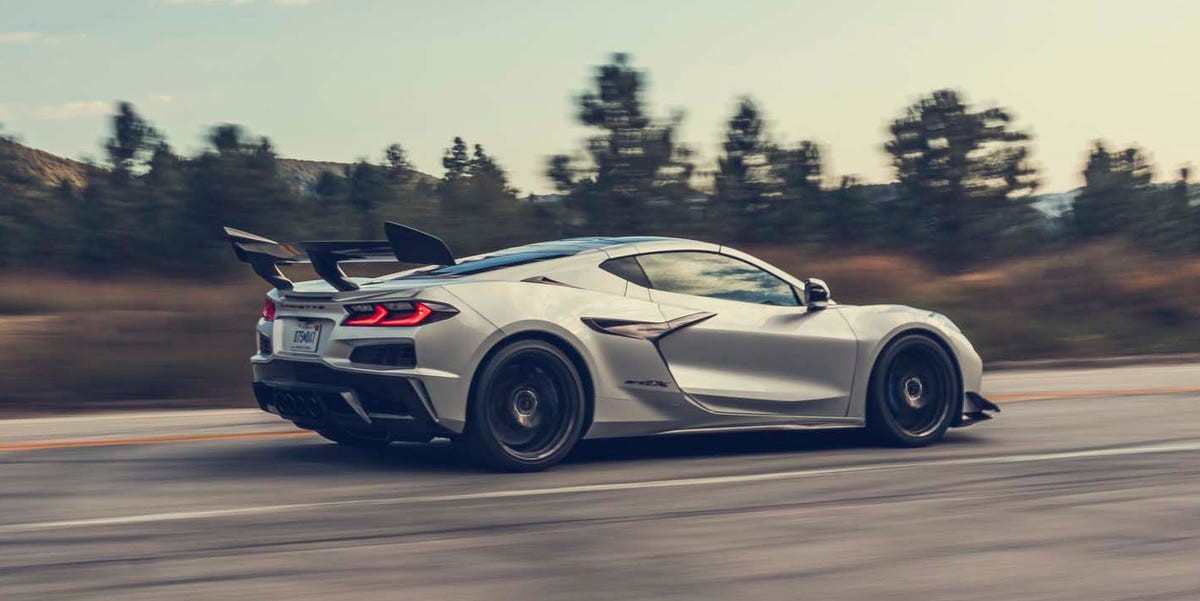
The automotive world often sees limits pushed, but the 2026 Chevrolet Corvette ZR1X isn’t just pushing them—it’s dismantling them. GM didn’t set out to create a sensible sports car. They built a machine that answers the question no one asked: “What happens when you combine a twin-turbo V-8 with an electric front axle?” The result is a 1250-horsepower all-wheel-drive monster that laughs in the face of practicality.
The Logic of Excess
Chevrolet’s approach is straightforward: take the high-revving 5.5-liter flat-plane V-8 from the Z06, twin-turbocharge it to produce 1064 horsepower, then add an electric front motor generating another 186 horsepower. Why? Because they could. The ZR1X isn’t about efficiency or restraint; it’s about proving what’s possible when engineering ambition overrides common sense. The electric motor isn’t just for show—it provides additional thrust up to 160 mph, designed for full drag-strip runs.
Performance and Control
This 4139-pound machine delivers staggering performance. Testing revealed a 0-60 mph time of 2.1 seconds and a quarter-mile sprint in 9.2 seconds at 155 mph, putting it neck-and-neck with hypercars like the Bugatti Chiron Super Sport and Lucid Air Sapphire. The ZR1X doesn’t just accelerate; it violently accelerates, with a sound described not as refined but as “released”—a guttural bark accompanying the mechanical fury under the hood.
But raw power isn’t the whole story. The ZR1X features re-architected electronic controls from the E-Ray, but with a crucial difference: instead of reacting to driver input, it predicts it. This preemptive system allows the car to manage its immense power with unnerving precision. The braking system, equipped with 10-piston front and six-piston rear calipers gripping 16.5-inch carbon-ceramic rotors, is equally impressive, stopping from 70 mph in just 139 feet.
The NHRA Problem
The ZR1X’s performance is so extreme that it raises legal questions. According to NHRA Street Legal rules, production cars shouldn’t exceed 9.0 seconds in the quarter-mile or 150 mph. Yet, even in less-than-ideal testing conditions, the ZR1X exceeded the speed limit, prompting the NHRA to vaguely promise “observation and learning opportunities” if owners attempt similar runs at the strip.
A Contradiction on Wheels
Despite its brutal capability, the ZR1X remains surprisingly livable. It has a functional trunk, rides smoothly, and even takes regular pump gas. It can be driven politely in Stealth mode, with limited electric range, while simultaneously possessing the potential to outpace a Mazda Miata using only its front tires. This duality is the essence of the ZR1X: it’s a machine that shouldn’t work this well, yet somehow does.
The ZR1X isn’t just a car; it’s an argument against self-imposed limits. It demonstrates that capability shouldn’t be restricted by practicality or regulations. The menu should extend to infinity, and the only constraint should be the willingness to push boundaries.
Ultimately, the 2026 Chevrolet Corvette ZR1X is a testament to the fact that sometimes, excess is the point.


